Guided tour · For everyone · One moment, ten places · about 1597–1610
The world around 1600
What were artists making around 1600? A journey westward from Japan to Spain, in ten works, most of them made within about ten years of that date.
Start this tour in AuriaanOpens the interactive flight at this tour, with a guide's voice. It needs a modern browser; the same works are shown below.
- Works
- 10
- Time
- about 16 min
- Collections
- 5
About this tour
Around the year 1600, ships, envoys and traders already linked much of the world, yet every place still had its own way of seeing. Here are ten works, most of them made within about ten years of 1600, on a journey westward, from Japan to Spain. At every work, look first, then discover.
We begin in Japan, where ships from Europe have just come into port.
The 10 works
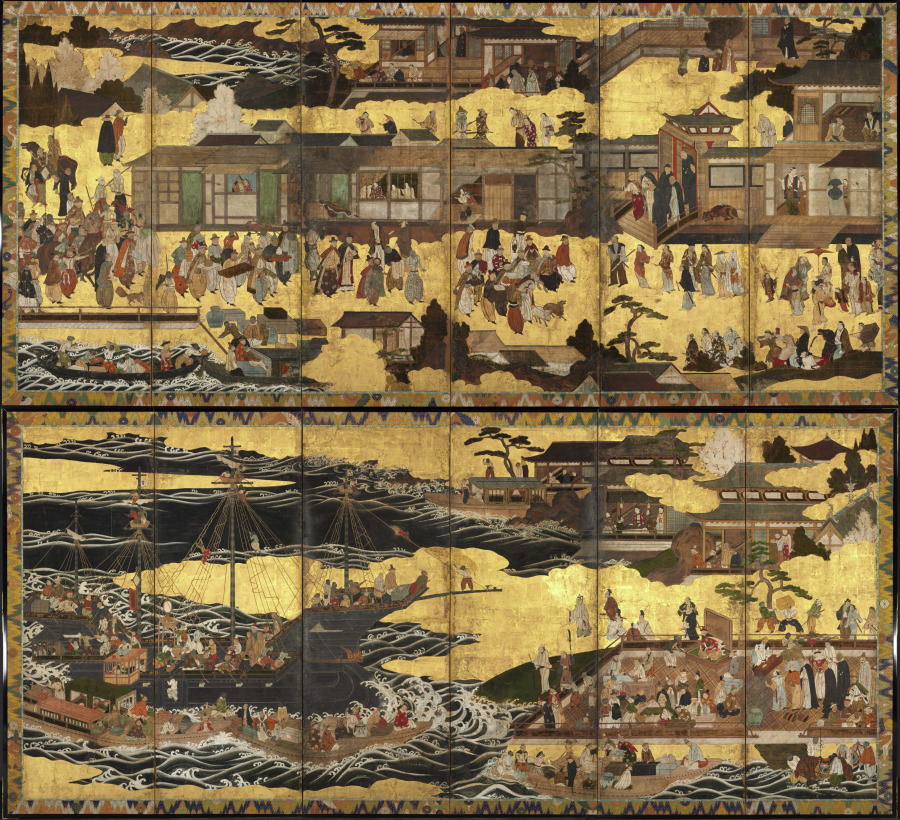
Leonard C. Hanna Jr. Fund · 1960.193 · View at the museum
Licence: CC0 (Open Access)Arrival of the "Southern Barbarians"
A huge black ship has come into port. Who is arriving?
Merchants from Europe, almost certainly Portuguese, with Roman Catholic priests and their cargo.
This pair of folding screens, in ink, colour and gold, shows the newcomers the Japanese called 'southern barbarians', because their ships came from the south. Later the Portuguese were forced out, and from 1641 to 1853 the Dutch were the only Europeans allowed to trade with Japan, and only from a port town near present-day Nagasaki.
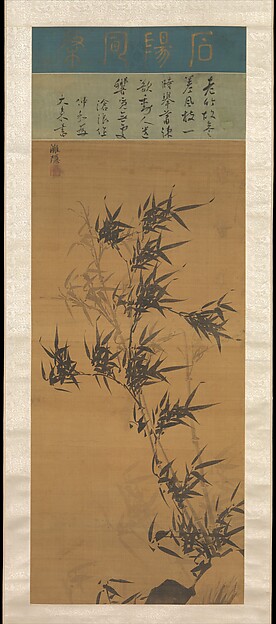
Mary Griggs Burke Collection, Gift of the Mary and Jackson Burke Foundation, 2015 · 2015.300.299 · View at the museum
Licence: CC0 (Open Access)Bamboo in the Wind
The wind is blowing through this bamboo, painted in dark and light ink. Can you find the paler bamboo?
Behind the dark stems stands a second bamboo in pale ink, as if seen through mist.
Yi Jeong, a member of the Korean royal family, was one of the great painters of bamboo. For scholars in Korea and China, bamboo stood for an upright person: it bends in the wind, but it does not break.
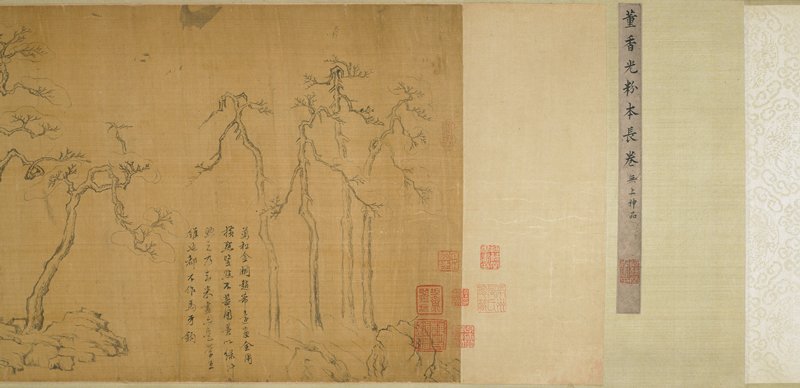
Minneapolis Institute of Art · Public Domain · 2005.9.3 · View at the museum
Licence: Public DomainStudies of Traditional Trees and Rocks
Trees, but no landscape around them. What is the artist doing?
Making a sourcebook. These are sketches of trees and rocks in the manner of older masters, which he copied from whenever he made a large composition.
Dong Qichang was a high official, a collector, and the most influential painter and critic of his time in China. He taught that painters should first learn from the great masters of the past, and then make the old styles their own.
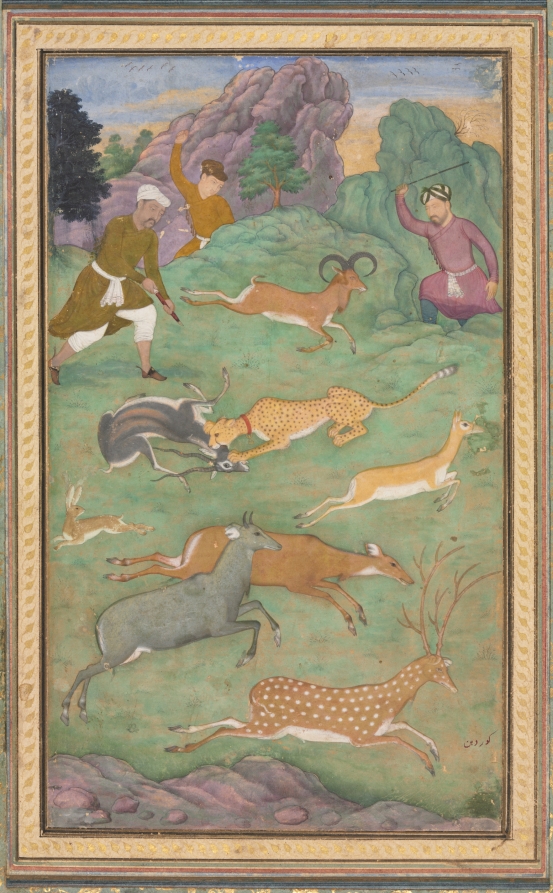
Dudley P. Allen Fund · 1939.66 · View at the museum
Licence: CC0 (Open Access)Antelope and deer hunt
A hunt at full gallop. Which animal is the hunter?
A cheetah with a red collar, catching a blackbuck. The Mughals trained cheetahs to hunt.
It was painted for Prince Salim, who loved hunting. Between 1600 and 1605 he set up his own court in defiance of his father, the emperor Akbar, and persuaded some imperial artists to join him. The young Govardhan, a Hindu, was one of them.
Purchase from the J. H. Wade Fund · 1947.497 · View at the museum
Licence: CC0 (Open Access)Youth Holding a Pomegranate
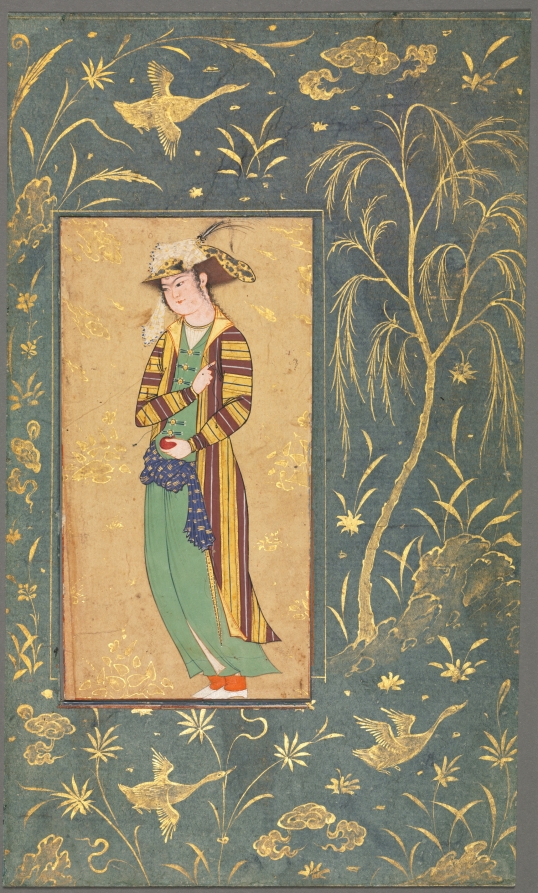
A young man in a striped coat. What is he holding?
A pomegranate, a favoured fruit.
It shows the style of Riza-yi Abbasi, the most gifted painter at the court of Shah Abbas, who made Isfahan his capital. Gold thread was so costly that rulers sometimes burned old fabrics to recover it. This youth is dressed less lavishly, with less gold thread than the youths in two other paintings: presumably a sign of lower status.

SMK – National Gallery of Denmark · Public Domain · KKSgb5208 · View at the museum
Licence: Public DomainView of the city of Prague
We look down on a city on a river. What crosses the water?
A long stone bridge on many arches: the bridge we now call the Charles Bridge.
Prague was then the home of the emperor Rudolf II, who gathered painters, scientists and astronomers at his court. Roelant Savery, a Flemish painter, worked for him and drew the city in pen and watercolour.
Rogers Fund, 1952 · 52.81 · View at the museum
Licence: CC0 (Open Access)The Musicians
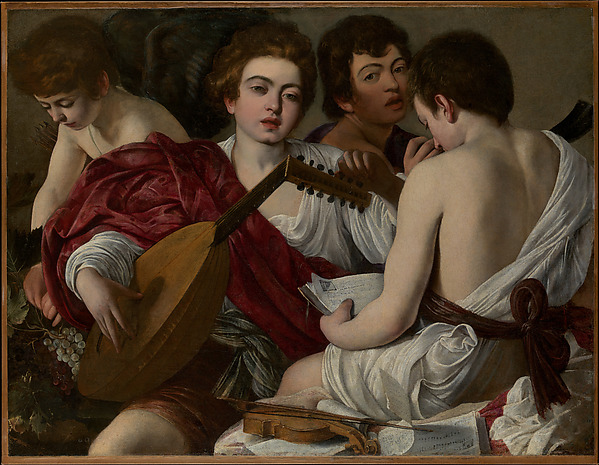
Four young men with music. One of them looks straight out at us. Who might he be?
Caravaggio himself: the young man behind, looking out of the picture, is a self-portrait.
Caravaggio painted it in Rome, most likely for his first major patron, Cardinal Francesco Maria del Monte. The young man looking out at us, second from the right, is the painter himself. On the left, a boy with wings eats grapes: he is Cupid, the god of love, and his presence makes this an allegory of music.

Patrons' Permanent Fund and Nell and Robert Weidenhammer Fund · 2000.4.1 · View at the museum
Licence: CC0 (Open Access)River Landscape
A ferry is coming in to land. Who and what is on board?
A baby. A boatman passes it to a man on the bank, while women, a girl and a dog wait nearby.
Jan Brueghel, a son of Pieter Bruegel, painted tiny, glowing scenes on copper in Antwerp. The ferry on the right is full of travellers, horses and cattle.
Fletcher Fund, 1935 · 35.89.2 · View at the museum
Licence: CC0 (Open Access)Portrait of a Woman
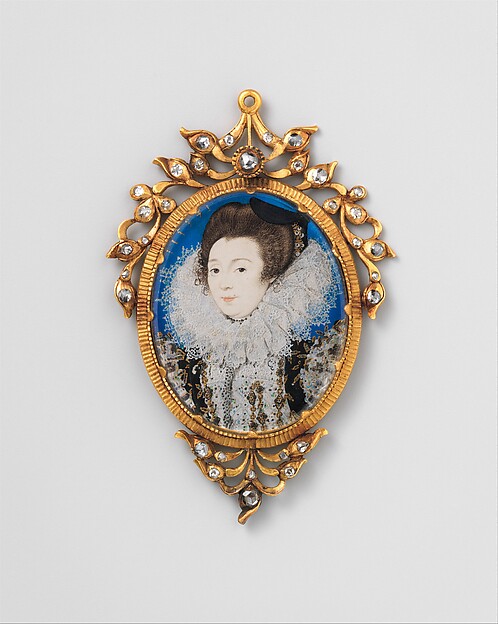
This portrait is small enough to hold in your hand. How is it kept?
In a gold frame set with jewels, to be worn or carried close.
Nicholas Hilliard painted portrait miniatures on vellum for Queen Elizabeth I and her court. Look at the ruff around her neck: every fold of lace, painted with the finest brush.

H. O. Havemeyer Collection, Bequest of Mrs. H. O. Havemeyer, 1929 · 29.100.6 · View at the museum
Licence: CC0 (Open Access)View of Toledo
A storm breaks over a city on a hill. What rises highest on the skyline?
The tower of the cathedral, and beside it the great square block of the Alcázar, the royal palace.
El Greco was born on Crete and worked in Venice and Rome before settling in Toledo. Landscapes are rare in his work; here the city itself becomes the subject, under stormy skies that turn the foliage a lurid green.
The end of the tour
Ten places, one moment.
European ships in Japan, bamboo in Korea, old masters studied in China, a hunt in India, a youth in Isfahan, Prague, Rome, Antwerp, London and Toledo: most within about ten years of 1600, on one journey west.
Questions at the end
Who were the 'southern barbarians' arriving in Japan?
- Portuguese merchants and priests (correct)
- Chinese fishermen
- Dutch painters
The screens almost certainly show Portuguese, since Roman Catholic priests come with them.
What hunts the blackbuck in Govardhan's painting?
- A cheetah with a red collar (correct)
- A tiger
- A falcon
The Mughals trained cheetahs to catch prey during their hunts.
Where did El Greco live when he painted this view?
- In Toledo (correct)
- On Crete
- In Venice
Born on Crete, he worked in Venice and Rome, then settled in Toledo for the rest of his life.
Works from these collections
- Cleveland Museum of Art
- The Metropolitan Museum of Art
- Minneapolis Institute of Art
- SMK – National Gallery of Denmark
- National Gallery of Art
More tours
- Artists of Switzerland in the world's museumsTen artists born or at home in Switzerland, from Liotard to Klee, in nine museums around the world.
- Animal huntEight animals are hiding in works of art from all over the world. Can you find them?
- 1,800 years of facesTen portraits, from Roman Egypt to Van Gogh. Look for the clues: who, when, and why?
- Blue and whiteHow cobalt blue on white travelled from China to Turkey, Holland, Japan, Mexico, Korea and England: ten pieces, roughly in the order they were made.
- The moonA god, a hare, a bodhisattva, a crescent, a castle, a jar, geese, photographs, the sea and a city by night: the moon in ten works from around the world.
- The seaWaves, a storm, a calm, a harbour and a sunrise: eight ways of looking at the sea, across 3,000 years.
- A walk through the seasonsA calm walk from spring to winter, in eight works. Large text, a gentle voice and no hurry.
- Look closerSeven famous works, each with a small detail most people miss. Find it yourself, then hear its story.
- How old is it?Eight works from four museums. Guess when each was made before you hear the story: some are far older than they look, and two are younger.
- Albrecht DürerEleven works by the painter and printmaker from Nuremberg: a self-portrait, a rhinoceros and a magic square.
- Rembrandt, in the mirrorTen self-portraits, painted, etched and drawn: from the curly-haired young man to the old master.
- VermeerThirteen of his rare paintings, in the order he made them: quiet rooms, letters and light.
- Giovanni Battista PiranesiRome, real and imagined, in the order he etched it: ruins, squares, prisons, temples and a fireplace.
- J. M. W. TurnerStorms, fire, moonlight and golden haze, in order of date: from a Welsh castle to a storm at sea.
- Hokusai & HiroshigeThe two masters of the Japanese landscape print, side by side: ten prints, in roughly the order they were made.
- Claude MonetEleven paintings in the order he made them: the sea, Camille, grainstacks, a cathedral, London fog and his pond.
- Mary CassattFrom Seville to Paris: a theatre box, a letter, an omnibus and a boat trip. Ten paintings, prints and a pastel, in the order she made them.
- Helene SchjerfbeckFrom a soldier in the snow to a face of a few strokes: ten works, in the order she made them.
- Van GoghTen years of work, from the grey Dutch coast to the colours of the south: eleven works, in the order he made them.
- Vilhelm HammershøiGrey rooms, white doors, light on the floor and a woman seen from behind: ten works, roughly in the order he made them.
Back to the start page · all tours · press