Guided tour · One artist · Paris · 1844–1926
Mary Cassatt
From Seville to Paris: a theatre box, a letter, an omnibus and a boat trip. Ten paintings, prints and a pastel, in the order she made them.
Start this tour in AuriaanOpens the interactive flight at this tour, with a guide's voice. It needs a modern browser; the same works are shown below.
- Works
- 10
- Time
- about 15 min
- Collections
- 6
About this tour
Mary Cassatt was born in Pennsylvania in 1844 and spent most of her working life in Paris. Here are ten of her paintings, prints and a pastel, from six museums, in the order she made them. At every work, look first, then discover.
We begin in 1873. Cassatt, a young American painter, has copied the old masters in Madrid and set up a studio in Seville.
The 10 works
Smithsonian American Art Museum, Smithsonian Institution · CC0 · 1967.40 · View at the museum
Licence: CC0Spanish Dancer Wearing a Lace Mantilla
Look closely at the lace over her head. How is it painted?
Quick, thick strokes of white over the dark: just dabs of paint up close, lace from a step back.
Shown at the Paris Salon of 1874, it is said to have made Degas exclaim: 'There is someone who feels as I do.'

Chester Dale Collection · 1963.10.96 · View at the museum
Licence: CC0 (Open Access)The Loge
There is one spot of blood red in this painting. Where?
A single red rose, among pale flowers and green leaves.
Two young women in a box at the theatre: one hides behind her fan, the other sits up straight. People came to see, and to be seen.

Paris Musées / Petit Palais · CC0 · PPP706 · View at the museum
Licence: CC0Automne, portrait de Lydia Cassatt
The title, Automne, means autumn. Where can you see it?
In the colours: her coat glows with rust and orange, like the autumn leaves around her.
Lydia, her elder sister, lived with Mary in Paris and often posed for her. She died only two years later, in 1882.

Ailsa Mellon Bruce Collection · 1970.17.19 · View at the museum
Licence: CC0 (Open Access)Children Playing on the Beach
The girl in front is completely absorbed. In what?
Filling her pail. One hand grips the long wooden spade; the pail sits between her ankles.
Cassatt shows children as they are: busy, unposed, not looking at us. Far out at sea, tiny boats sail by.

Chester Dale Collection · 1963.10.97 · View at the museum
Licence: CC0 (Open Access)Girl Arranging Her Hair
What is she doing with her hands?
Putting up her hair: one hand holds her braid, the other reaches behind her head.
Degas is said to have claimed that women had no style; this was her answer. He took it in exchange for one of his own works and kept it until his death.

Bequest of Charles T. Brooks · 1941.71 · View at the museum
Licence: CC0 (Open Access)In the Omnibus
Look out of the windows. What is going by?
A river and an arched stone bridge: they are riding through Paris on an omnibus.
The nanny watches the baby; the mother gazes outside. On the omnibus, men and women of different classes could mix.

Rosenwald Collection · 1943.3.2763 · View at the museum
Licence: CC0 (Open Access)The Letter
What is she doing with the envelope?
Sealing it: she presses the flap to her lips.
The flat blue, the patterned wallpaper and the view from above show what she learned from Japanese prints.

Chester Dale Collection · 1963.10.94 · View at the museum
Licence: CC0 (Open Access)The Boating Party
Where are the woman and the baby looking?
Towards the man at the oars, or just past him: we barely see his face.
Flat shapes, an unusual angle and a horizon pushed up to the top edge: the lessons of the Japanese prints, now in oil paint.
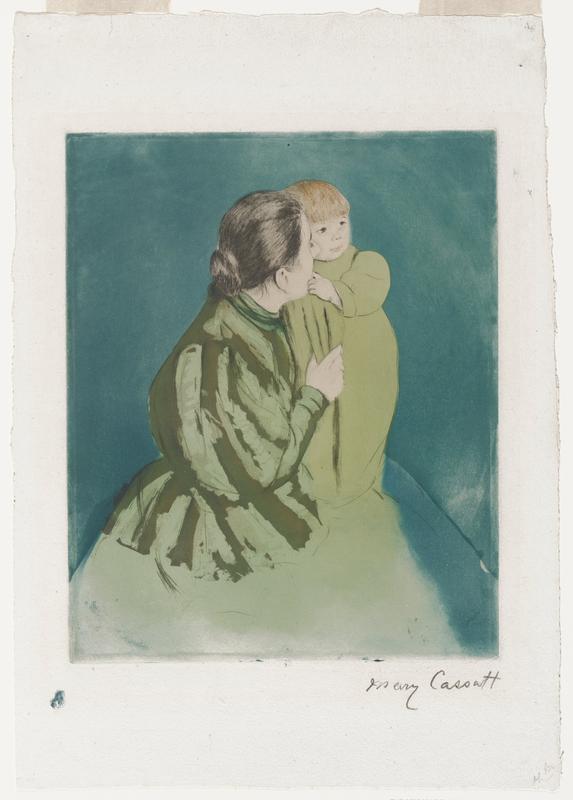
Minneapolis Institute of Art · Public Domain · 2018.76 · View at the museum
Licence: Public DomainMother and Child
Whose face can you see?
Only the child's, peeking over her shoulder. The mother's face is turned away, pressed close.
It looks effortless, but it took three copper plates, inked in colour and printed one after another, and touches of colour by hand.

Yale University Art Gallery · Public Domain · 2005.101.1 · View at the museum
Licence: Public DomainBoy with Golden Curls (Portrait of Harris Whittemore Jr.)
This is pastel, not paint. Where can you see the strokes?
In the slanting green lines on the chair and the golden lines of his hair: each one a stroke of coloured chalk.
Cassatt drew him in 1898, on a visit to his family in Connecticut.
The end of the tour
Modern life, seen up close.
A theatre box, a letter, an omnibus ride, a boat trip: Cassatt pictured the everyday lives of women and children, from close by. Failing eyesight ended her work in her last years. She died in France in 1926.
Questions at the end
After Madrid, where did Cassatt set up a studio?
- Seville (correct)
- Rome
- London
After copying the Spanish masters in Madrid, she set up a studio in Seville.
Which painter traded one of his own works for Girl Arranging Her Hair?
- Edgar Degas (correct)
- Claude Monet
- Édouard Manet
Degas had claimed that women had no style. He traded for the painting and kept it until his death.
What inspired her set of ten colour prints of 1890–91?
- An exhibition of Japanese prints in Paris (correct)
- A journey to Japan
- Photographs of Paris streets
In 1890 she saw a great exhibition of Japanese woodcuts at the École des Beaux-Arts in Paris.
Works from these collections
- Smithsonian Institution
- National Gallery of Art
- Paris Musées
- Cleveland Museum of Art
- Minneapolis Institute of Art
- Yale University Art Gallery
More tours
- Artists of Switzerland in the world's museumsTen artists born or at home in Switzerland, from Liotard to Klee, in nine museums around the world.
- Animal huntEight animals are hiding in works of art from all over the world. Can you find them?
- 1,800 years of facesTen portraits, from Roman Egypt to Van Gogh. Look for the clues: who, when, and why?
- The world around 1600What were artists making around 1600? A journey westward from Japan to Spain, in ten works, most of them made within about ten years of that date.
- Blue and whiteHow cobalt blue on white travelled from China to Turkey, Holland, Japan, Mexico, Korea and England: ten pieces, roughly in the order they were made.
- The moonA god, a hare, a bodhisattva, a crescent, a castle, a jar, geese, photographs, the sea and a city by night: the moon in ten works from around the world.
- The seaWaves, a storm, a calm, a harbour and a sunrise: eight ways of looking at the sea, across 3,000 years.
- A walk through the seasonsA calm walk from spring to winter, in eight works. Large text, a gentle voice and no hurry.
- Look closerSeven famous works, each with a small detail most people miss. Find it yourself, then hear its story.
- How old is it?Eight works from four museums. Guess when each was made before you hear the story: some are far older than they look, and two are younger.
- Albrecht DürerEleven works by the painter and printmaker from Nuremberg: a self-portrait, a rhinoceros and a magic square.
- Rembrandt, in the mirrorTen self-portraits, painted, etched and drawn: from the curly-haired young man to the old master.
- VermeerThirteen of his rare paintings, in the order he made them: quiet rooms, letters and light.
- Giovanni Battista PiranesiRome, real and imagined, in the order he etched it: ruins, squares, prisons, temples and a fireplace.
- J. M. W. TurnerStorms, fire, moonlight and golden haze, in order of date: from a Welsh castle to a storm at sea.
- Hokusai & HiroshigeThe two masters of the Japanese landscape print, side by side: ten prints, in roughly the order they were made.
- Claude MonetEleven paintings in the order he made them: the sea, Camille, grainstacks, a cathedral, London fog and his pond.
- Helene SchjerfbeckFrom a soldier in the snow to a face of a few strokes: ten works, in the order she made them.
- Van GoghTen years of work, from the grey Dutch coast to the colours of the south: eleven works, in the order he made them.
- Vilhelm HammershøiGrey rooms, white doors, light on the floor and a woman seen from behind: ten works, roughly in the order he made them.
Back to the start page · all tours · press