Guided tour · One artist · Venice · Rome · 1720–1778
Giovanni Battista Piranesi
Rome, real and imagined, in the order he etched it: ruins, squares, prisons, temples and a fireplace.
Start this tour in AuriaanOpens the interactive flight at this tour, with a guide's voice. It needs a modern browser; the same works are shown below.
- Works
- 11
- Time
- about 16 min
- Collections
- 7
About this tour
Giovanni Battista Piranesi trained as an architect in Venice, then moved to Rome and etched it as no one had before: its ruins, its squares, and prisons that exist only on paper. Here are eleven of his works from seven museums, in the order he made them. At every work, look first, then discover.
We begin in Rome around 1743. Piranesi, in his early twenties, has just published his first book of etchings.
The 11 works

Los Angeles County Museum of Art · Public Domain · AC1995.54.1.11 · View at the museum
Licence: Public DomainMagnificent Architectural Space
What is pouring water into the basin?
A lion's head. Beside the fountain, tiny people stand and sit, dwarfed by the halls.
His caption calls it a group of stairs leading to a rotunda for theatre. It is from his first book of etchings, published in 1743.
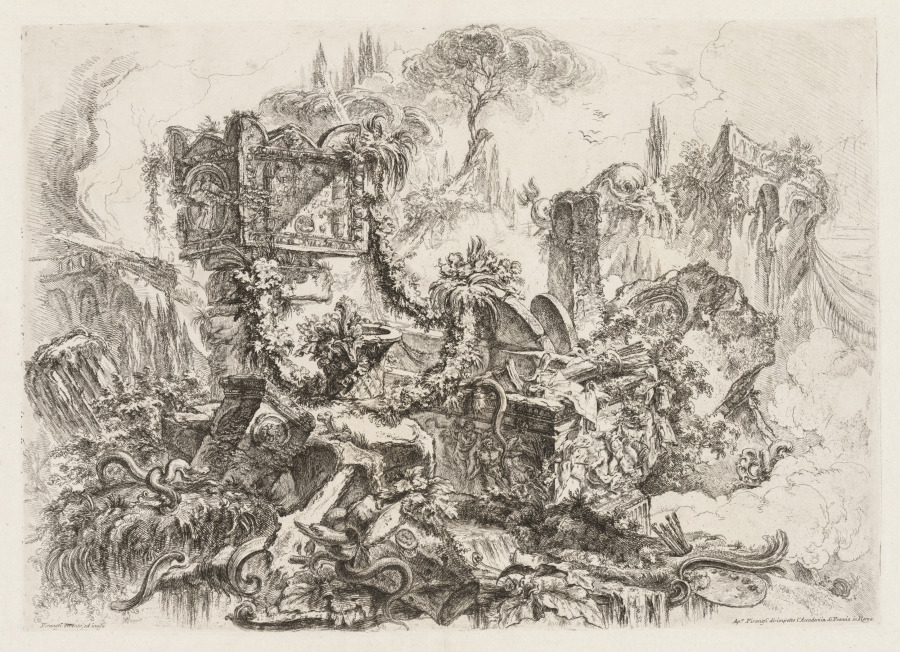
Mr. and Mrs. Charles G. Prasse Collection · 1974.255 · View at the museum
Licence: CC0 (Open Access)The Tomb of Nero
What is slithering through the ruins?
Snakes, winding among broken stones and overgrown plants.
It looks like pure fantasy, but the tomb was based on a real monument Piranesi had seen near Rome.
Harris Brisbane Dick Fund, 1937 · 37.45.3(44) · View at the museum
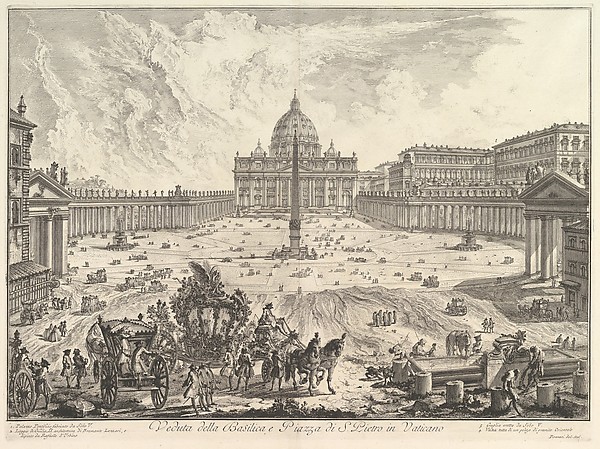
Licence: CC0 (Open Access)View of St. Peter's Basilica and Piazza in the Vatican
What is waiting at the front of the square?
A coach and horses, among people out walking in their tricorn hats.
This is an early print: the first of seven known versions of the copper plate, which was changed again and again.

W.G. Russell Allen, Ailsa Mellon Bruce, Lessing J. Rosenwald, and Pepita Milmore Funds · 1976.35.5 · View at the museum
Licence: CC0 (Open Access)The Drawbridge
Find the drawbridge. Who is on it?
Two small figures, at its far end. Ropes and beams criss-cross the vast space all around them.
From his Imaginary Prisons (Carceri), first published around 1750: vast, impossible vaults, all invented.
Harris Brisbane Dick Fund, 1937 · 37.45.3(52) · View at the museum
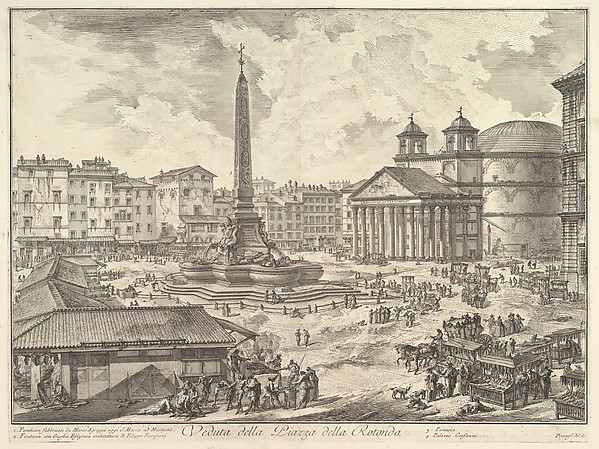
Licence: CC0 (Open Access)The Piazza della Rotonda, with the Pantheon and Obelisk
What sits on top of the Pantheon's porch?
Two small bell towers. They were added in the 1600s and taken down in the 1880s.
In front, a market fills the square, around a fountain topped by an Egyptian obelisk.

Rijksmuseum, Amsterdam · Public Domain · RP-P-OB-39.546 · View at the museum
Licence: Public DomainFundering van de Engelenburcht te Rome
How big are the people next to these stones?
Tiny. One of them points at the blocks, which look like the work of giants.
These are the foundations of Emperor Hadrian's tomb, today Castel Sant'Angelo. Piranesi wanted to show how the Romans built.

Yale University Art Gallery · Public Domain · 2012.159.11.59 · View at the museum
Licence: Public DomainView of the Flavian Amphitheatre, called the Colosseum
Look through the arches of the second storey. What is inside?
Not the arena, but broken inner walls, overgrown with plants.
It was the largest amphitheatre of ancient Rome. For centuries its fallen stone was carted off to build palaces and churches.

Mark J. Millard Architectural Collection, acquired with assistance from The Morris and Gwendolyn Cafritz Foundation · 1983.118.6 · View at the museum
Licence: CC0 (Open Access)The Lion Bas-Reliefs
Which animal is carved into the stone below?
A lion, carved in relief like ancient Roman sculpture. A second one hides on the left.
This plate was new in 1761. He reworked the old ones too, with deeper shadows, more chains and more architecture.

Mr. and Mrs. Charles G. Prasse Collection · 1967.236 · View at the museum
Licence: CC0 (Open Access)Temple of the Sibyl at Tivoli
What decorates the band above the columns?
Garlands and ox heads, carved in stone. On top, small bushes have taken root.
His caption says that this is only its common name: some thought it was a temple of Hercules.

The Elisha Whittelsey Collection, The Elisha Whittelsey Fund, 1973 · 1973.509.8 · View at the museum
Licence: CC0 (Open Access)Chimneypiece in the Egyptian style
What spreads its wings above the fire?
Two winged sphinxes, with a lion's face between them. Above: Egyptian heads, hieroglyphs and stars.
Piranesi championed the Egyptian style, then rare in Europe. He decorated a café in Rome, the English Coffee House, in this style.
SMK – National Gallery of Denmark · Public Domain · KKSgb9875/11 · View at the museum
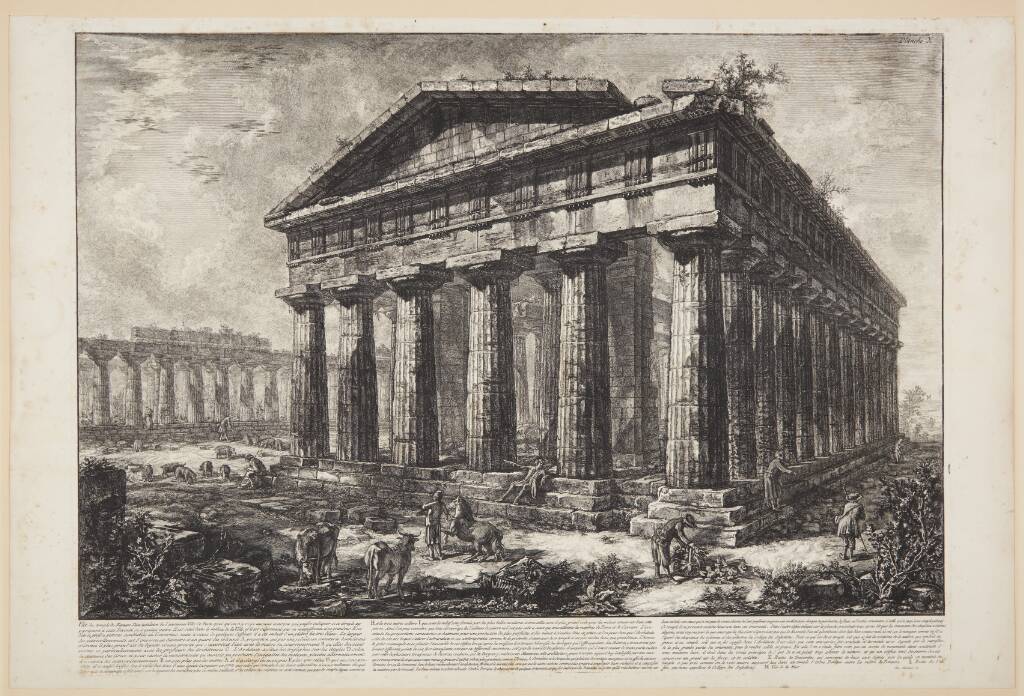
Licence: Public DomainView of the Temple of Neptune
Who has come to the old temple?
A herdsman with his pigs, resting among the fallen stones. Beside the columns, they all look small.
The temple is Greek, about 2,500 years old. The Paestum views were his last great series.
The end of the tour
Rome, real and imagined.
Piranesi died in Rome in 1778, aged 58. His views shaped how Europe saw Rome, and his imaginary prisons have fascinated artists ever since.
Questions at the end
What are Piranesi's Carceri?
- Imaginary prisons (correct)
- Maps of Venice
- Portraits of popes
Vast, impossible interiors he invented. He reissued them in 1761, darker and with two new plates.
How did Piranesi make most of these works?
- Etching on copper plates (correct)
- Oil painting on canvas
- Carving in marble
He drew through a wax coating on copper, let acid bite the lines, and printed from the plate.
What sat on the Pantheon's porch in Piranesi's day?
- Two small bell towers (correct)
- A golden statue
- A clock
They were added in the 1600s and taken down in the 1880s.
Works from these collections
- Los Angeles County Museum of Art
- Cleveland Museum of Art
- The Metropolitan Museum of Art
- National Gallery of Art
- Rijksmuseum
- Yale University Art Gallery
- SMK – National Gallery of Denmark
More tours
- Artists of Switzerland in the world's museumsTen artists born or at home in Switzerland, from Liotard to Klee, in nine museums around the world.
- Animal huntEight animals are hiding in works of art from all over the world. Can you find them?
- 1,800 years of facesTen portraits, from Roman Egypt to Van Gogh. Look for the clues: who, when, and why?
- The world around 1600What were artists making around 1600? A journey westward from Japan to Spain, in ten works, most of them made within about ten years of that date.
- Blue and whiteHow cobalt blue on white travelled from China to Turkey, Holland, Japan, Mexico, Korea and England: ten pieces, roughly in the order they were made.
- The moonA god, a hare, a bodhisattva, a crescent, a castle, a jar, geese, photographs, the sea and a city by night: the moon in ten works from around the world.
- The seaWaves, a storm, a calm, a harbour and a sunrise: eight ways of looking at the sea, across 3,000 years.
- A walk through the seasonsA calm walk from spring to winter, in eight works. Large text, a gentle voice and no hurry.
- Look closerSeven famous works, each with a small detail most people miss. Find it yourself, then hear its story.
- How old is it?Eight works from four museums. Guess when each was made before you hear the story: some are far older than they look, and two are younger.
- Albrecht DürerEleven works by the painter and printmaker from Nuremberg: a self-portrait, a rhinoceros and a magic square.
- Rembrandt, in the mirrorTen self-portraits, painted, etched and drawn: from the curly-haired young man to the old master.
- VermeerThirteen of his rare paintings, in the order he made them: quiet rooms, letters and light.
- J. M. W. TurnerStorms, fire, moonlight and golden haze, in order of date: from a Welsh castle to a storm at sea.
- Hokusai & HiroshigeThe two masters of the Japanese landscape print, side by side: ten prints, in roughly the order they were made.
- Claude MonetEleven paintings in the order he made them: the sea, Camille, grainstacks, a cathedral, London fog and his pond.
- Mary CassattFrom Seville to Paris: a theatre box, a letter, an omnibus and a boat trip. Ten paintings, prints and a pastel, in the order she made them.
- Helene SchjerfbeckFrom a soldier in the snow to a face of a few strokes: ten works, in the order she made them.
- Van GoghTen years of work, from the grey Dutch coast to the colours of the south: eleven works, in the order he made them.
- Vilhelm HammershøiGrey rooms, white doors, light on the floor and a woman seen from behind: ten works, roughly in the order he made them.
Back to the start page · all tours · press