Guided tour · One artist · Nuremberg · 1471–1528
Albrecht Dürer
Eleven works by the painter and printmaker from Nuremberg: a self-portrait, a rhinoceros and a magic square.
Start this tour in AuriaanOpens the interactive flight at this tour, with a guide's voice. It needs a modern browser; the same works are shown below.
- Works
- 11
- Time
- about 17 min
- Collections
- 6
About this tour
Albrecht Dürer of Nuremberg was a painter, a draughtsman and above all a printmaker: his woodcuts and engravings made him famous all over Europe. Eleven works, from a drawing he made at 22 to a portrait engraved two years before he died. At every work, look first, then discover.
We begin in 1493. Dürer is 22, a young painter on his travels.
The 11 works

Robert Lehman Collection, 1975 · 1975.1.862 · View at the museum
Licence: CC0 (Open Access)Self-portrait, Study of a Hand and a Pillow
Dürer drew three things on this sheet. Can you find them?
His own face, a hand and, below, a pillow. He was practising on what was in front of him, himself included.
On the back of the sheet are six more pillows. Dürer first drew himself at thirteen, and kept doing so all his life.

Samuel H. Kress Collection · 1952.2.16.a · View at the museum
Licence: CC0 (Open Access)Madonna and Child
Look out of the window on the left. What do you see?
A landscape with a winding path to a walled fortification, painted in tiny detail.
The calm Madonna in front of a curtain recalls the paintings Dürer had seen in Venice. On the back of the panel he painted Lot fleeing from Sodom.

Gift of Junius Spencer Morgan, 1919 · 19.73.209 · View at the museum
Licence: CC0 (Open Access)The Four Horsemen, from the Apocalypse
Four riders storm across the sky. What do they carry?
A bow, a sword and a pair of scales. The fourth rider, in front on a thin horse, is Death.
Dürer published the Apocalypse himself, fifteen large woodcuts in one book. It made his name all over Europe.

Fletcher Fund, 1919 · 19.73.65 · View at the museum
Licence: CC0 (Open Access)Saint Eustace
The hunter has stopped and knelt. What has he seen?
A crucifix between the antlers of a stag. In the legend, the Roman general Placidus became a Christian, baptised with the name Eustace.
It is Dürer's largest engraving, crowded with detail. Count the five dogs at the bottom.
The Friedsam Collection, Bequest of Michael Friedsam, 1931 · 32.100.64 · View at the museum
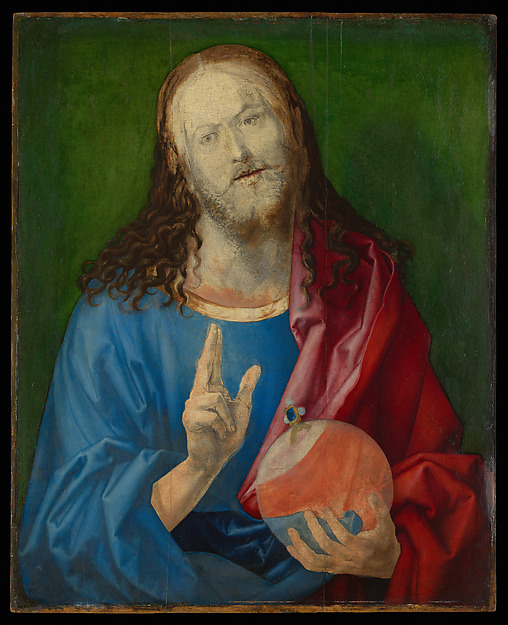
Licence: CC0 (Open Access)Salvator Mundi
Something is not finished in this painting. What?
The face and the hands: they are still only drawing. Only the robes are finished.
Dürer probably began it shortly before he set off for Italy again, in 1505. We can see how he worked: a precise drawing first, then layers of colour.

Gift of W.G. Russell Allen · 1941.1.20 · View at the museum
Licence: CC0 (Open Access)Knight, Death and Devil
Who rides along with the knight?
Death, with a snake in his crown, holding up an hourglass, and behind them a horned devil. The knight rides on, looking straight ahead.
With Saint Jerome in his Study and Melencolia I, it is one of Dürer's three 'master engravings'.

Princeton University Art Museum · Public Domain · x1949-208 · View at the museum
Licence: Public DomainSaint Jerome in his Study
Who is lying on the floor?
A lion, Jerome's faithful companion, and beside it a dog.
Sunlight falls through the round window panes into a calm, orderly room. At the back the saint, who translated the Bible into Latin, sits writing.

Gift of Leonard C. Hanna Jr., in memory of Ralph King · 1926.211 · View at the museum
Licence: CC0 (Open Access)Melencolia I
On the wall is a square full of numbers. Which year is hidden in it?
In the bottom row, 15 and 14: 1514. Every row, column and diagonal adds up to 34.
Melancholy was linked to creative minds. The winged figure sits among her tools, unable to use them.
Städel Museum, Frankfurt am Main · Public Domain · 31588 · View at the museum
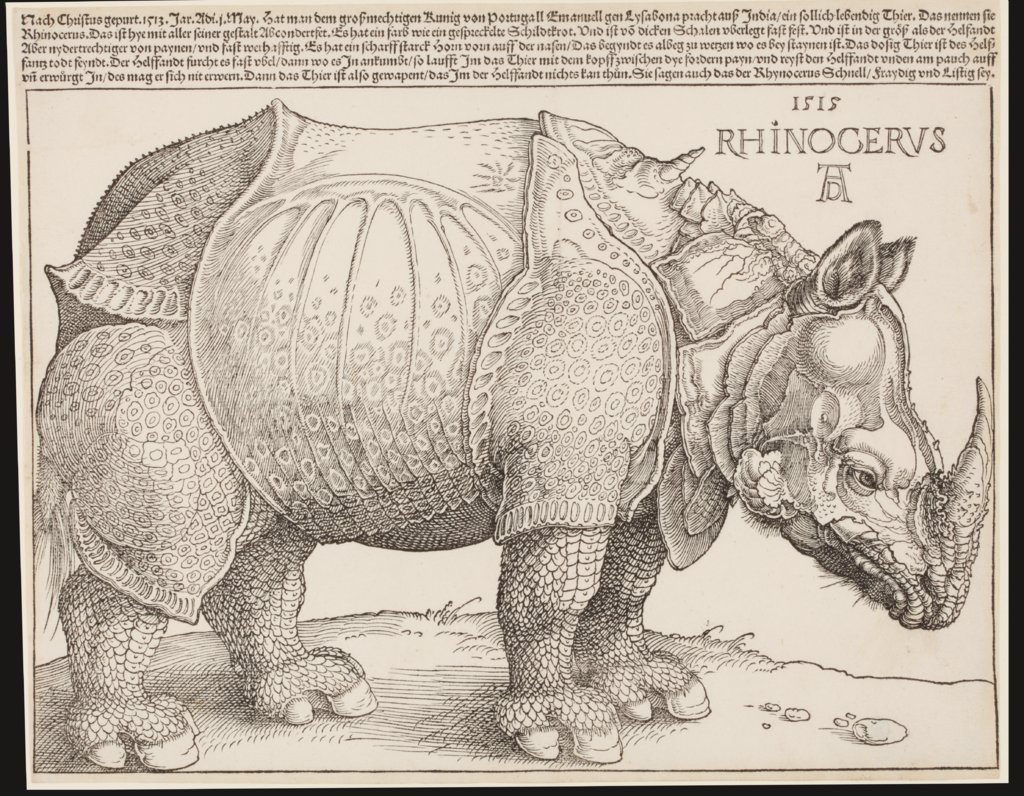
Licence: Public DomainRhinoceros
Dürer never saw this animal. Can you spot what he got wrong?
Its skin is a suit of armour plates and scales, and it has a small extra horn on its back.
It had been sent from India to the king of Portugal. No one in Europe had seen a rhinoceros since ancient times, and Dürer's picture shaped how Europeans saw it for centuries.

Samuel H. Kress Collection · 1952.2.17 · View at the museum
Licence: CC0 (Open Access)Portrait of a Clergyman
Find Dürer's signature.
The date, 1516, and his monogram: a D standing between the legs of a large A.
The sitter may be the clergyman Johann Dorsch. Unusually, it is painted on parchment, not on wood.

Yale University Art Gallery · Public Domain · 1937.291 · View at the museum
Licence: Public DomainErasmus of Rotterdam
The tablet is in Latin and in Greek, and the Latin tells us who this is. What could the Greek line say?
'His writings will show a better image.' The Latin says that Dürer drew Erasmus from life.
Dürer had drawn Erasmus in the Netherlands in 1520; the engraving followed six years later.
The end of the tour
From a pillow to Erasmus.
Drawings, paintings, woodcuts and engravings: Dürer mastered them all, and signed them with his famous monogram, AD. He died in Nuremberg in 1528.
Questions at the end
What is hidden in the magic square of Melencolia I?
- The year it was made, 1514 (correct)
- Dürer's birthday
- The number of the Apostles
The two middle numbers of the bottom row read 15 and 14.
Why does Dürer's rhinoceros look as if it wears armour?
- He had never seen one (correct)
- Rhinos wore armour in battle
- It was a mechanical toy
He worked from descriptions and a drawing sent from Lisbon.
How did Dürer sign his works?
- With a D inside a large A (correct)
- With a small rhinoceros
- With his full name in gold
His monogram AD appears on his prints and paintings alike.
Works from these collections
- The Metropolitan Museum of Art
- National Gallery of Art
- Princeton University Art Museum
- Cleveland Museum of Art
- Städel Museum
- Yale University Art Gallery
More tours
- Artists of Switzerland in the world's museumsTen artists born or at home in Switzerland, from Liotard to Klee, in nine museums around the world.
- Animal huntEight animals are hiding in works of art from all over the world. Can you find them?
- 1,800 years of facesTen portraits, from Roman Egypt to Van Gogh. Look for the clues: who, when, and why?
- The world around 1600What were artists making around 1600? A journey westward from Japan to Spain, in ten works, most of them made within about ten years of that date.
- Blue and whiteHow cobalt blue on white travelled from China to Turkey, Holland, Japan, Mexico, Korea and England: ten pieces, roughly in the order they were made.
- The moonA god, a hare, a bodhisattva, a crescent, a castle, a jar, geese, photographs, the sea and a city by night: the moon in ten works from around the world.
- The seaWaves, a storm, a calm, a harbour and a sunrise: eight ways of looking at the sea, across 3,000 years.
- A walk through the seasonsA calm walk from spring to winter, in eight works. Large text, a gentle voice and no hurry.
- Look closerSeven famous works, each with a small detail most people miss. Find it yourself, then hear its story.
- How old is it?Eight works from four museums. Guess when each was made before you hear the story: some are far older than they look, and two are younger.
- Rembrandt, in the mirrorTen self-portraits, painted, etched and drawn: from the curly-haired young man to the old master.
- VermeerThirteen of his rare paintings, in the order he made them: quiet rooms, letters and light.
- Giovanni Battista PiranesiRome, real and imagined, in the order he etched it: ruins, squares, prisons, temples and a fireplace.
- J. M. W. TurnerStorms, fire, moonlight and golden haze, in order of date: from a Welsh castle to a storm at sea.
- Hokusai & HiroshigeThe two masters of the Japanese landscape print, side by side: ten prints, in roughly the order they were made.
- Claude MonetEleven paintings in the order he made them: the sea, Camille, grainstacks, a cathedral, London fog and his pond.
- Mary CassattFrom Seville to Paris: a theatre box, a letter, an omnibus and a boat trip. Ten paintings, prints and a pastel, in the order she made them.
- Helene SchjerfbeckFrom a soldier in the snow to a face of a few strokes: ten works, in the order she made them.
- Van GoghTen years of work, from the grey Dutch coast to the colours of the south: eleven works, in the order he made them.
- Vilhelm HammershøiGrey rooms, white doors, light on the floor and a woman seen from behind: ten works, roughly in the order he made them.
Back to the start page · all tours · press