Guided tour · For everyone · From China to the world · 1350–1790
Blue and white
How cobalt blue on white travelled from China to Turkey, Holland, Japan, Mexico, Korea and England: ten pieces, roughly in the order they were made.
Start this tour in AuriaanOpens the interactive flight at this tour, with a guide's voice. It needs a modern browser; the same works are shown below.
- Works
- 10
- Time
- about 15 min
- Collections
- 7
About this tour
Blue painted on white: few looks have travelled so far. Our story starts in China, with cobalt brought from Persia. Then people around the world admired it, traded it, copied it and made it their own. Here are ten pieces from seven museums, roughly in the order they were made. At every work, look first, then discover.
We begin in China, in the 1300s, at the kilns of Jingdezhen.
The 10 works

Purchase, Mrs. Richard E. Linburn Gift, 1987 · 1987.10 · View at the museum
Licence: CC0 (Open Access)Plate
Something swims in the middle of this big plate. What is it?
A fish with spiky fins, gliding between water plants.
The potters of Jingdezhen painted it with cobalt under a clear glaze, then fired it. The cobalt came from Persia, far to the west, and many big plates like this one went back west, to buyers in the Islamic world.
National Palace Museum, Taipei · CC BY 4.0 · C1B004724N000000000PAA · View at the museum
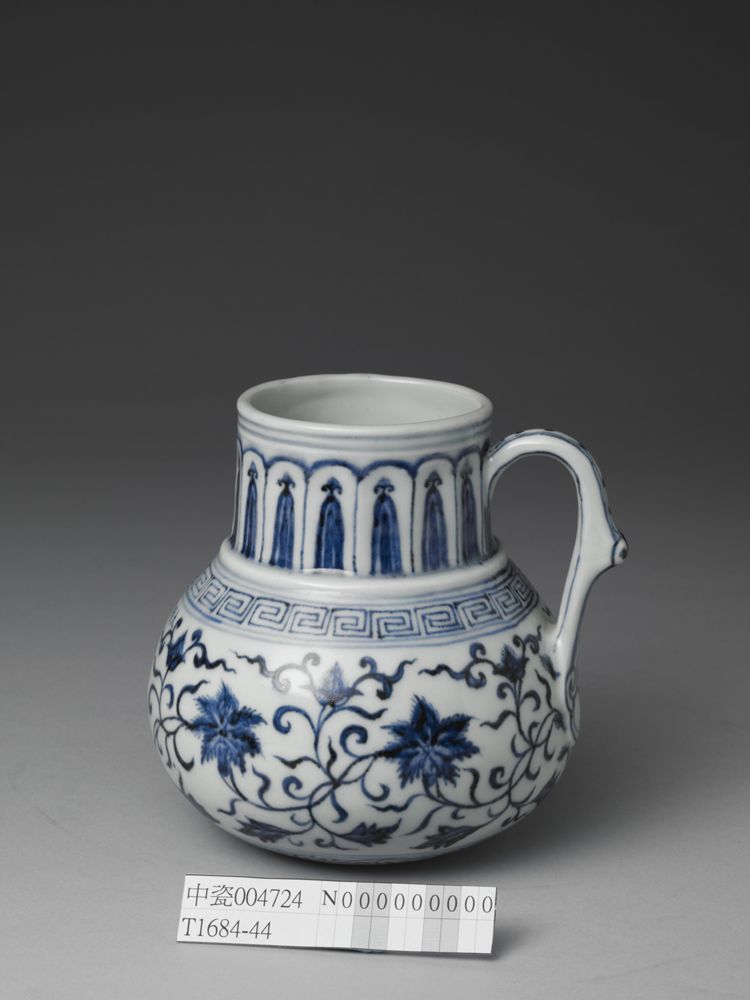
Licence: CC BY 4.0Tankard with floral decoration in underglaze blue
This is Chinese porcelain, but its shape came from far away. Which part gives it away?
The handle and the tall straight neck: the shape of a metal tankard from the Islamic world.
Potters at the imperial kilns copied the shapes of metal and jade vessels from Central Asia and the Middle East. This one is now in the National Palace Museum in Taipei.
Severance and Greta Millikin Collection · 1964.170 · View at the museum
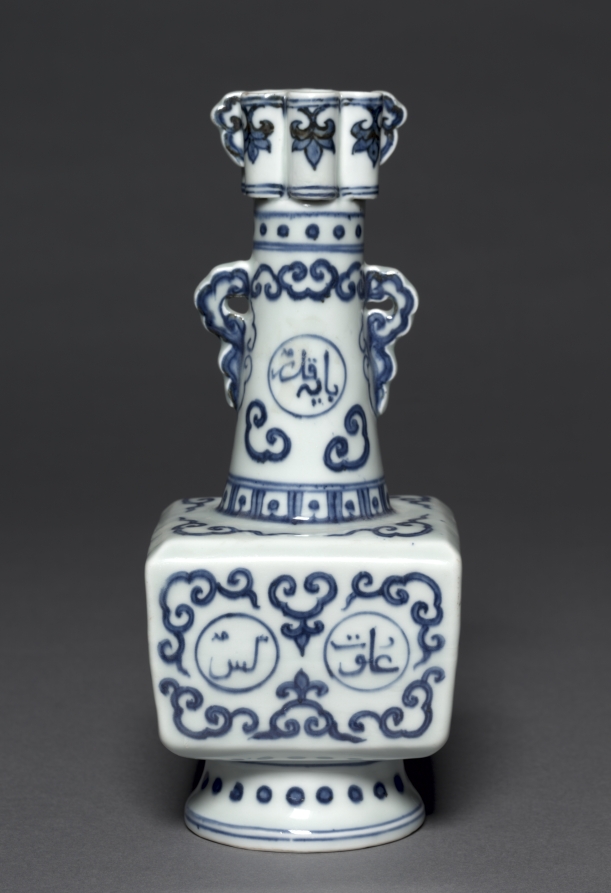
Licence: CC0 (Open Access)Arrow Vase with Persian Inscriptions and Floral Scrolls
There is writing on this vase. Can you find it?
Words in Persian, written in blue inside the circles. There is more on the neck.
An arrow vase was used in an old Chinese game: players threw arrows into its neck. Chinese potters of the 1500s took in foreign shapes, motifs and ideas, to suit new customers in a world that was growing more connected.

Harris Brisbane Dick Fund, 1966 · 66.4.2 · View at the museum
Licence: CC0 (Open Access)Footed Dish with Foliate Rim in Imitation of Chinese Porcelain
This dish looks Chinese. Is it?
No. It was made in Turkey, around 1575, in imitation of Chinese porcelain.
Many Ottoman sultans were avid collectors of Chinese porcelain. Turkish potters made their copies not in porcelain but in stonepaste, painted in blue under a clear glaze.

Rijksmuseum, Amsterdam · Public Domain · SK-A-1522 · View at the museum
Licence: Public DomainStill Life with Flowers in a Wan-Li Vase
A grand bouquet. What holds it?
A Chinese vase, painted in blue, with a gilded mount around its neck. Porcelain was so precious that Europeans set it in gold and silver.
Bosschaert painted on copper, flower by flower. The vase is Chinese porcelain from the reign of the Wanli emperor, a kind that often appears in Bosschaert's still lifes.

Minneapolis Institute of Art · Public Domain · 2015.79.296 · View at the museum
Licence: Public DomainPot with the Initials L. G.
This bottle was made for one particular person. Who?
L.G.: the initials of the client who ordered it, probably someone in Europe. Nobody knows who.
It was made in Arita, in western Japan, and painted with a brush in cobalt blue before firing. It would have left from the port of Imari for Europe, probably on a ship of the Dutch East India Company.

Yale University Art Gallery · Public Domain · RR2017.6336.1 · View at the museum
Licence: Public DomainApothecary Jar
Blue flowers crowd every part of this jar but one. Where?
A broad white band sweeps around the jar, left almost bare.
Damian Hernandez made it in Mexico, then part of New Spain, for a pharmacy. Chinese porcelain reached Mexico on the Manila galleons, which crossed the Pacific every year, and Mexican potters answered with blue and white of their own, on tin-glazed earthenware.
Severance and Greta Millikin Purchase Fund · 2024.27 · View at the museum
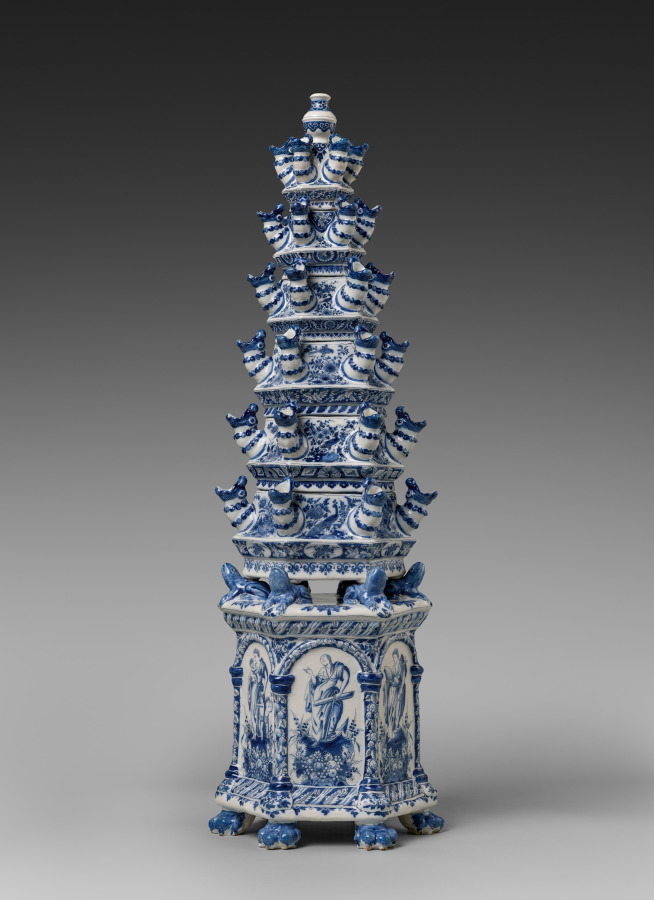
Licence: CC0 (Open Access)Flower Pyramid
What do you think this tall tower was for?
Flowers. The spouts are where flowers can be placed, so the whole tower becomes a column of blooms.
Flower pyramids were among the most complex and luxurious ceramics made in Delft in the late 1600s. This one comes from the Greek A factory, which made pieces for Queen Mary II of England. Faith, Hope and Love decorate the base.
Los Angeles County Museum of Art · Public Domain · M.2000.15.98 · View at the museum
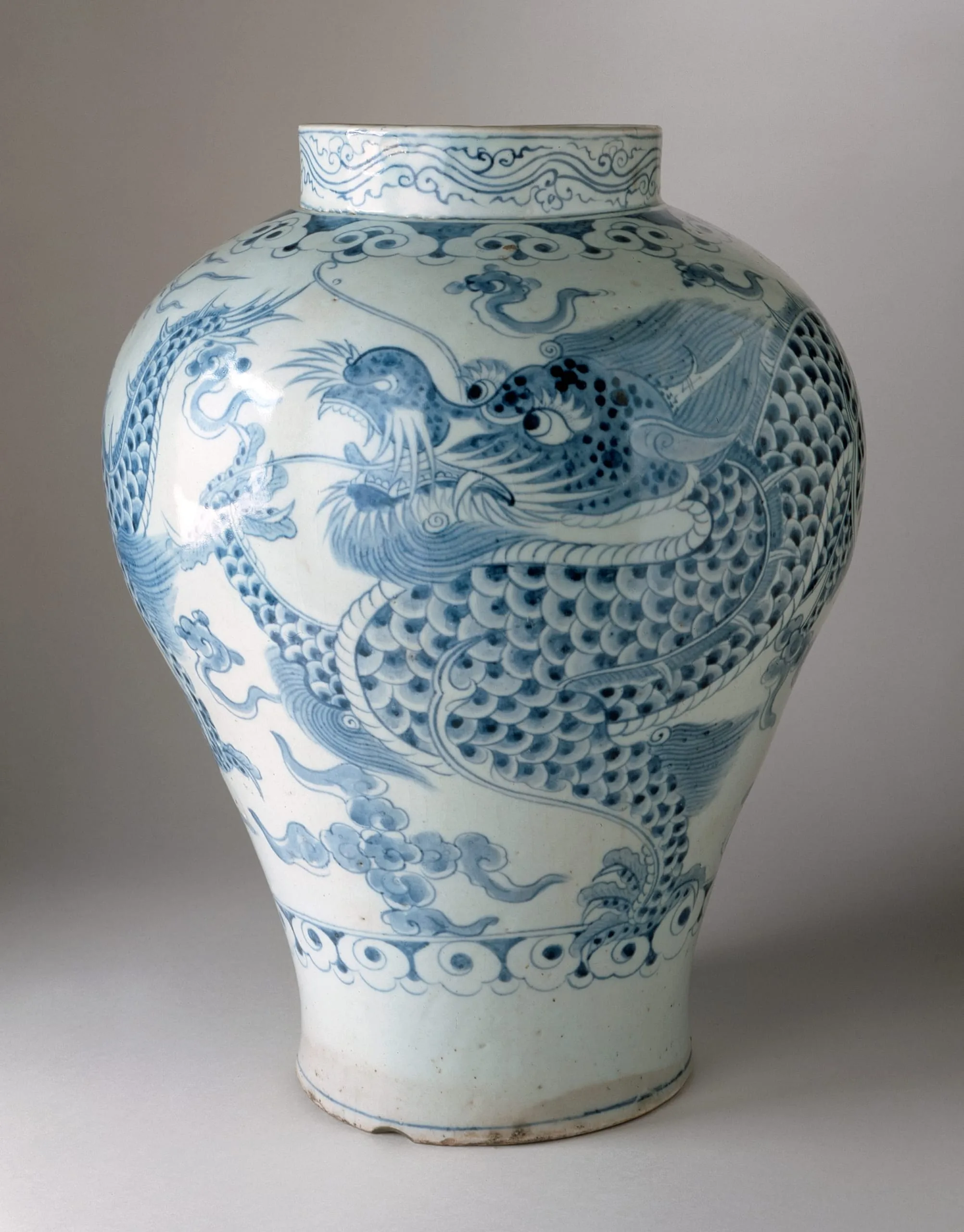
Licence: Public DomainJar with Dragon in Clouds Design in Underglaze Cobalt - blue
A dragon winds around this jar. Can you find its face?
Round eyes, long whiskers and sharp teeth, painted with quick strokes of blue.
Korean potters made blue and white from the 1400s on. The cobalt was costly, so at first only the royal household could use these wares. The dragon was an emblem of the king.
Minneapolis Institute of Art · Public Domain · 97.41.2.2a, b · View at the museum
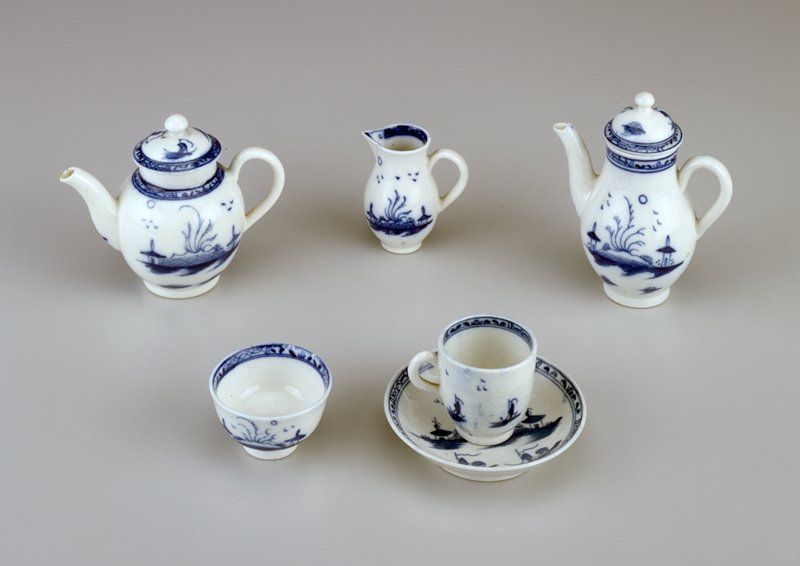
Licence: Public DomainTea pot, from a child's tea set, in blue and white
A teapot from a child's tea set, made in England. What kind of landscape is on it?
A Chinese-style scene: water, reeds, birds and little pavilions.
More than four hundred years after Jingdezhen, an English factory decorated a tea set small enough for a child's hands with a Chinese-style scene in blue and white.
The end of the tour
Blue and white, around the world.
From Jingdezhen to Turkey, Holland, Arita, Mexico, Korea and an English toy tea set: the same two colours, admired, copied and made new for more than four hundred years.
Questions at the end
Where did the cobalt for the plate from Jingdezhen come from?
- Persia (correct)
- Japan
- Holland
In the 1300s, the potters of Jingdezhen painted with cobalt brought from Persia.
What was the tall Delft tower made for?
- Holding flowers (correct)
- Keeping tea warm
- Storing spices
Its six tiers have spouts where flowers can be placed.
Whom were the initials L.G. painted for?
- An unknown client, probably in Europe (correct)
- The potter in Arita
- The captain of the ship
The initials belong to an unknown, probably European, client who ordered the bottle.
Works from these collections
- The Metropolitan Museum of Art
- National Palace Museum
- Cleveland Museum of Art
- Rijksmuseum
- Minneapolis Institute of Art
- Yale University Art Gallery
- Los Angeles County Museum of Art
More tours
- Artists of Switzerland in the world's museumsTen artists born or at home in Switzerland, from Liotard to Klee, in nine museums around the world.
- Animal huntEight animals are hiding in works of art from all over the world. Can you find them?
- 1,800 years of facesTen portraits, from Roman Egypt to Van Gogh. Look for the clues: who, when, and why?
- The world around 1600What were artists making around 1600? A journey westward from Japan to Spain, in ten works, most of them made within about ten years of that date.
- The moonA god, a hare, a bodhisattva, a crescent, a castle, a jar, geese, photographs, the sea and a city by night: the moon in ten works from around the world.
- The seaWaves, a storm, a calm, a harbour and a sunrise: eight ways of looking at the sea, across 3,000 years.
- A walk through the seasonsA calm walk from spring to winter, in eight works. Large text, a gentle voice and no hurry.
- Look closerSeven famous works, each with a small detail most people miss. Find it yourself, then hear its story.
- How old is it?Eight works from four museums. Guess when each was made before you hear the story: some are far older than they look, and two are younger.
- Albrecht DürerEleven works by the painter and printmaker from Nuremberg: a self-portrait, a rhinoceros and a magic square.
- Rembrandt, in the mirrorTen self-portraits, painted, etched and drawn: from the curly-haired young man to the old master.
- VermeerThirteen of his rare paintings, in the order he made them: quiet rooms, letters and light.
- Giovanni Battista PiranesiRome, real and imagined, in the order he etched it: ruins, squares, prisons, temples and a fireplace.
- J. M. W. TurnerStorms, fire, moonlight and golden haze, in order of date: from a Welsh castle to a storm at sea.
- Hokusai & HiroshigeThe two masters of the Japanese landscape print, side by side: ten prints, in roughly the order they were made.
- Claude MonetEleven paintings in the order he made them: the sea, Camille, grainstacks, a cathedral, London fog and his pond.
- Mary CassattFrom Seville to Paris: a theatre box, a letter, an omnibus and a boat trip. Ten paintings, prints and a pastel, in the order she made them.
- Helene SchjerfbeckFrom a soldier in the snow to a face of a few strokes: ten works, in the order she made them.
- Van GoghTen years of work, from the grey Dutch coast to the colours of the south: eleven works, in the order he made them.
- Vilhelm HammershøiGrey rooms, white doors, light on the floor and a woman seen from behind: ten works, roughly in the order he made them.
Back to the start page · all tours · press