Guided tour · One artist · Copenhagen · 1864–1916
Vilhelm Hammershøi
Grey rooms, white doors, light on the floor and a woman seen from behind: ten works, roughly in the order he made them.
Start this tour in AuriaanOpens the interactive flight at this tour, with a guide's voice. It needs a modern browser; the same works are shown below.
- Works
- 10
- Time
- about 15 min
- Collections
- 4
About this tour
Vilhelm Hammershøi lived and worked in Copenhagen. He painted quiet rooms, closed doors, empty squares and people seen from behind, in greys and soft light. Here are ten of his works from four museums, roughly in the order he made them. At every work, look first, then discover.
We begin in Copenhagen in 1886. Hammershøi is in his early twenties.
The 10 works

SMK – National Gallery of Denmark · Public Domain · KKS17964 · View at the museum
Licence: Public DomainThe Artist's Sister Anna Reading
The open book is the lightest thing in this drawing. How did he make it so light?
He left it as bare paper. All around it, he built up the darks with charcoal.
Anna, his younger sister, was one of his first models. A portrait of her was his debut at Copenhagen's Charlottenborg exhibition, in 1885.

SMK – National Gallery of Denmark · Public Domain · KMS3671 · View at the museum
Licence: Public DomainWoman Seen from the Back
She is busy with something. Can you see what?
No. Her back is turned, and her body hides her hands. We are left to guess.
Figures turned away from us became one of Hammershøi's favourite subjects. A plain wall, a table and a chair are all the setting he needs.

SMK – National Gallery of Denmark · Public Domain · KMS1808 · View at the museum
Licence: Public DomainEvening in the Drawing Room. The Artist's Mother and Wife
What is the brightest thing in this dark room?
The white cloth in her lap, catching the little light there is.
On the left sits Ida, his new wife; on the right, his mother. Neither looks up.

SMK – National Gallery of Denmark · Public Domain · KMS1542 · View at the museum
Licence: Public DomainAmalienborg Square, Copenhagen
This royal square is in the heart of Copenhagen. What is missing?
People. Not a soul crosses the square, not even a carriage.
The rider is King Frederik V, among the palaces of Amalienborg. Hammershøi painted his city as quietly as his rooms.
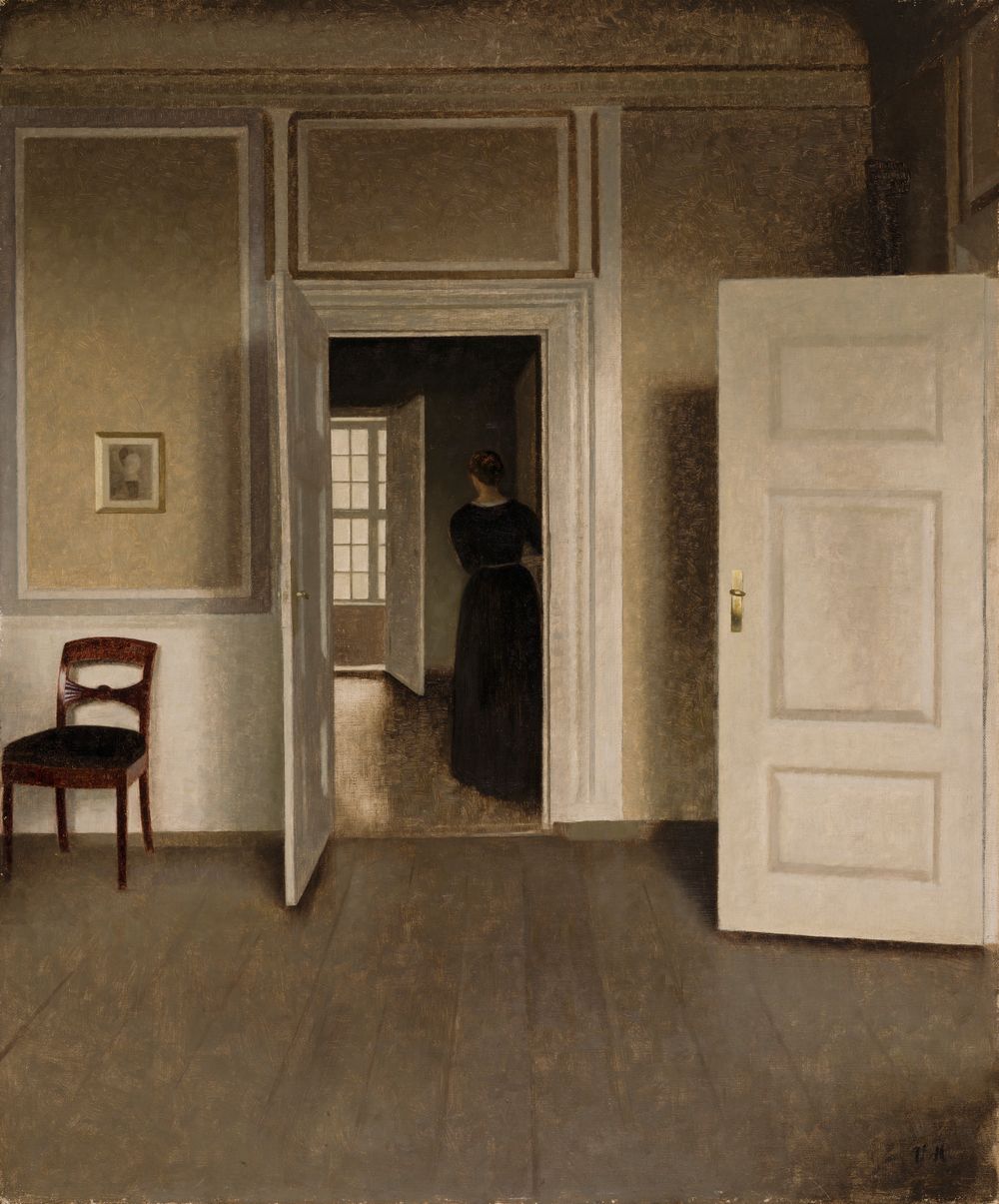
Finnish National Gallery, Ateneum Art Museum · CC0 · A III 2058 · View at the museum
Licence: CC0Interior from the Home of the Artist
Look through the open doors. Is anyone there?
A woman in black, in the next room, with her back to us.
This is his flat at Strandgade 30 in Copenhagen. He often painted his wife, Ida, there, seen from behind.

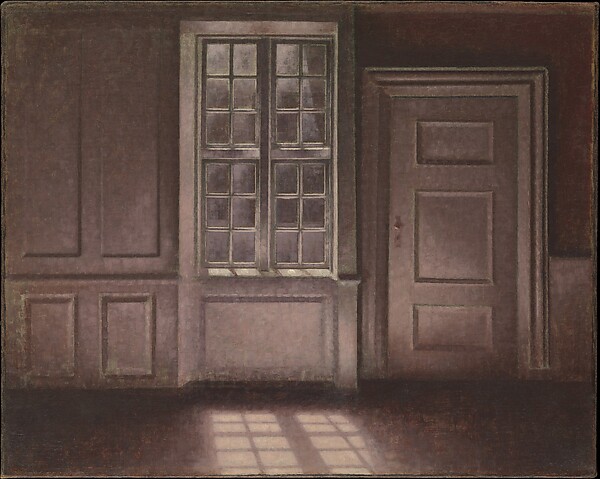
SMK – National Gallery of Denmark · Public Domain · KMS3696 · View at the museum
Licence: Public DomainInterior in Strandgade, Sunlight on the Floor
Where does the sun reach in this room?
The floor, where it draws the window panes as a bright grid.
'I personally prefer the Old; old buildings, old furniture,' Hammershøi told a magazine in 1909.
Purchase, European Paintings Funds, and Annette de la Renta Gift, 2012 · 2012.203 · View at the museum
Licence: CC0 (Open Access)Moonlight, Strandgade 30
The same kind of light on the floor. What is different?
It is night. The moon throws the window onto the floor, in a dim, pale light.
Hammershøi painted the rooms of his home at Strandgade 30 again and again: by day, and, as here, by night.

SMK – National Gallery of Denmark · Public Domain · KMS3352 · View at the museum
Licence: Public DomainIda Hammershøi, the Artist's Wife, with a Teacup
What is she holding in her right hand?
A teaspoon, dipped in her cup. But her eyes are elsewhere.
Ida was his most faithful model. Here we see her face, but she does not look at us.
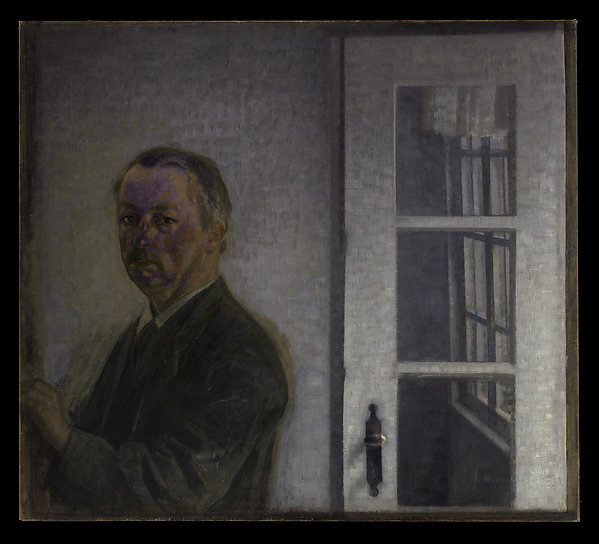
Gift of Charles Hack and the Hearn Family Trust, in honor of Keith Christiansen, and in celebration of the Museum's 150th Anniversary, 2020 · 2020.287 · View at the museum
Licence: CC0 (Open Access)Self-Portrait at Spurveskjul
He has raised one hand, as if painting. Which hand is it?
His left. But Hammershøi was right-handed: he painted his reflection in a mirror.
Spurveskjul ('Sparrow's Hideaway') was the summer house. Behind him, a sunlit door and window.

J. Paul Getty Museum · CC0 · descriptions CC BY 4.0 · 2018.59 · View at the museum
Licence: CC0 (descriptions CC BY 4.0)Interior with an Easel, Bredgade 25
There is no window in sight. Where does the light come from?
From windows we never see. Their sunlight falls in pale, slanting shapes on the walls and floor.
His flat and studio at Bredgade 25 in Copenhagen. By now his quiet interiors were known far beyond Denmark.
The end of the tour
Ten quiet pictures.
Closed doors, empty squares, light on bare floors, and people who turn away from us. Hammershøi died in Copenhagen in 1916, only 51, when his interiors were known far beyond Denmark.
Questions at the end
What did Hammershøi tell a magazine he preferred, in 1909?
- The Old: old buildings, old furniture (correct)
- Bright, modern colours
- Painting out of doors
'I personally prefer the Old; old buildings, old furniture,' he said.
How can we tell that he painted the Spurveskjul self-portrait from a mirror?
- He shows his left hand painting, but he was right-handed (correct)
- He signed it in mirror writing
- The window is painted back to front
The hand raised as if painting is his left: a right-handed painter, seen in a mirror.
Whom did he often paint from behind, in their flat at Strandgade 30?
- His wife, Ida (correct)
- His sister, Anna
- A maid
He often included a view of Ida from behind in his interiors.
Works from these collections
- SMK – National Gallery of Denmark
- Finnish National Gallery
- The Metropolitan Museum of Art
- J. Paul Getty Museum
More tours
- Artists of Switzerland in the world's museumsTen artists born or at home in Switzerland, from Liotard to Klee, in nine museums around the world.
- Animal huntEight animals are hiding in works of art from all over the world. Can you find them?
- 1,800 years of facesTen portraits, from Roman Egypt to Van Gogh. Look for the clues: who, when, and why?
- The world around 1600What were artists making around 1600? A journey westward from Japan to Spain, in ten works, most of them made within about ten years of that date.
- Blue and whiteHow cobalt blue on white travelled from China to Turkey, Holland, Japan, Mexico, Korea and England: ten pieces, roughly in the order they were made.
- The moonA god, a hare, a bodhisattva, a crescent, a castle, a jar, geese, photographs, the sea and a city by night: the moon in ten works from around the world.
- The seaWaves, a storm, a calm, a harbour and a sunrise: eight ways of looking at the sea, across 3,000 years.
- A walk through the seasonsA calm walk from spring to winter, in eight works. Large text, a gentle voice and no hurry.
- Look closerSeven famous works, each with a small detail most people miss. Find it yourself, then hear its story.
- How old is it?Eight works from four museums. Guess when each was made before you hear the story: some are far older than they look, and two are younger.
- Albrecht DürerEleven works by the painter and printmaker from Nuremberg: a self-portrait, a rhinoceros and a magic square.
- Rembrandt, in the mirrorTen self-portraits, painted, etched and drawn: from the curly-haired young man to the old master.
- VermeerThirteen of his rare paintings, in the order he made them: quiet rooms, letters and light.
- Giovanni Battista PiranesiRome, real and imagined, in the order he etched it: ruins, squares, prisons, temples and a fireplace.
- J. M. W. TurnerStorms, fire, moonlight and golden haze, in order of date: from a Welsh castle to a storm at sea.
- Hokusai & HiroshigeThe two masters of the Japanese landscape print, side by side: ten prints, in roughly the order they were made.
- Claude MonetEleven paintings in the order he made them: the sea, Camille, grainstacks, a cathedral, London fog and his pond.
- Mary CassattFrom Seville to Paris: a theatre box, a letter, an omnibus and a boat trip. Ten paintings, prints and a pastel, in the order she made them.
- Helene SchjerfbeckFrom a soldier in the snow to a face of a few strokes: ten works, in the order she made them.
- Van GoghTen years of work, from the grey Dutch coast to the colours of the south: eleven works, in the order he made them.
Back to the start page · all tours · press