Guided tour · For everyone
The sea
Waves, a storm, a calm, a harbour and a sunrise: eight ways of looking at the sea, across 3,000 years.
Start this tour in AuriaanOpens the interactive flight at this tour, with a guide's voice. It needs a modern browser; the same works are shown below.
- Works
- 8
- Time
- about 7 min
- Collections
- 5
About this tour
Eight works about the sea, from Japan to America and from about 1200 BC to the 1870s. Each one begins with a moment of just looking. The tour moves on by itself; pause whenever you like.
We start with the most famous wave in the world.
The 8 works

Rogers Fund, 1914 · JP10 · View at the museum
Licence: CC0 (Open Access)Under the Wave off Kanagawa (The Great Wave)
What do you see first: the wave, the boats, or the mountain?
Most people see the wave first. But in the middle, small and calm, is Mount Fuji.
Katsushika Hokusai was about seventy when he made this woodblock print. Thousands were printed; this one is in New York.

Gift of John Goldsmith Phillips, 1976 · 1976.646 · View at the museum
Licence: CC0 (Open Access)The Great Wave, Sète
This is a photograph from 1857. What is moving, and what is still?
The wave is caught at the moment it breaks, while the clouds seem to stand still.
Photography was still new, and the bright sky and the dark sea were very hard to catch in one picture. Gustave Le Gray's sea photographs stunned people at the time and made his name far beyond France.

Rijksmuseum, Amsterdam · Public Domain · SK-A-1848 · View at the museum
Licence: Public DomainA Ship on the High Seas Caught by a Squall, Known as “The Gust”
Something has gone wrong on this ship. Can you see what?
A sudden gust of wind has broken one of its masts, and a sail has come loose.
Willem van de Velde knew ships inside out: he and his father painted the sea for the English king. This warship carries seventy guns, and still the wind is stronger.

Yale Center for British Art, Paul Mellon Collection · Public Domain · B1977.14.77 · View at the museum
Licence: Public DomainDort, or Dordrecht: The Dort Packet-Boat from Rotterdam Becalmed
There is almost no wind. How can you tell?
The sails hang still, and every boat is mirrored in the smooth water.
J.M.W. Turner painted this after a journey to the Netherlands. “Becalmed” means the boat has no wind to sail with. Everything glows in soft, golden light.
Purchase, Louise Eldridge McBurney Gift, 1953 · 53.11.6 · View at the museum
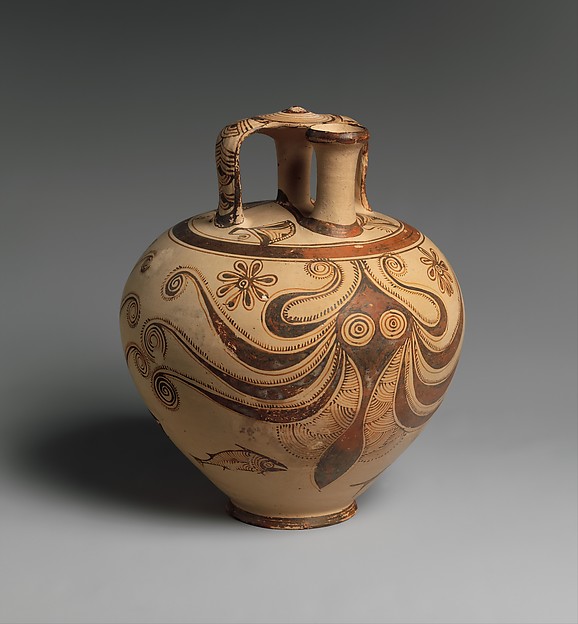
Licence: CC0 (Open Access)Terracotta stirrup jar with octopus
What creature wraps its arms around this jar?
An octopus on each side, with fish beside it! Their curling arms almost meet around the jar.
This jar was made in Greece more than 3,000 years ago; jars like it were used to carry liquids. Octopuses were a favourite design on jars like this.

Gift of the W. L. and May T. Mellon Foundation · 1943.13.1 · View at the museum
Licence: CC0 (Open Access)Breezing Up (A Fair Wind)
Where do you feel the wind? How is the boat moving?
The boat leans over, the sail is full, and the boys lean back against the wind.
Winslow Homer loved the sea and painted boys sailing. He worked on this picture for several years.

Ailsa Mellon Bruce Collection · 1970.17.48 · View at the museum
Licence: CC0 (Open Access)The Harbor at Lorient
Who is sitting on the wall? What is she doing?
A young woman in white with a pink parasol, looking down at the water.
She is the painter's sister, Edma, who also painted. Berthe Morisot painted it loosely, catching the shimmering light on the water. A few years later she was one of the Impressionists.

J. Paul Getty Museum · CC0 · descriptions CC BY 4.0 · 98.PA.164 · View at the museum
Licence: CC0 (descriptions CC BY 4.0)Sunrise (Marine)
What time of day is it? How can you tell?
Very early morning. The sun is just rising through the mist, and its orange light dances on the water.
Claude Monet painted the harbour of Le Havre at dawn in 1873, quickly and outdoors. It is one of the first works in the style soon called Impressionism.
The end of the tour
Eight seas.
A wave, a photograph, a storm, a calm, an octopus, a fair wind, a harbour and a sunrise. Which one will you remember?
Works from these collections
- The Metropolitan Museum of Art
- Rijksmuseum
- Yale Center for British Art
- National Gallery of Art
- J. Paul Getty Museum
More tours
- Artists of Switzerland in the world's museumsTen artists born or at home in Switzerland, from Liotard to Klee, in nine museums around the world.
- Animal huntEight animals are hiding in works of art from all over the world. Can you find them?
- 1,800 years of facesTen portraits, from Roman Egypt to Van Gogh. Look for the clues: who, when, and why?
- The world around 1600What were artists making around 1600? A journey westward from Japan to Spain, in ten works, most of them made within about ten years of that date.
- Blue and whiteHow cobalt blue on white travelled from China to Turkey, Holland, Japan, Mexico, Korea and England: ten pieces, roughly in the order they were made.
- The moonA god, a hare, a bodhisattva, a crescent, a castle, a jar, geese, photographs, the sea and a city by night: the moon in ten works from around the world.
- A walk through the seasonsA calm walk from spring to winter, in eight works. Large text, a gentle voice and no hurry.
- Look closerSeven famous works, each with a small detail most people miss. Find it yourself, then hear its story.
- How old is it?Eight works from four museums. Guess when each was made before you hear the story: some are far older than they look, and two are younger.
- Albrecht DürerEleven works by the painter and printmaker from Nuremberg: a self-portrait, a rhinoceros and a magic square.
- Rembrandt, in the mirrorTen self-portraits, painted, etched and drawn: from the curly-haired young man to the old master.
- VermeerThirteen of his rare paintings, in the order he made them: quiet rooms, letters and light.
- Giovanni Battista PiranesiRome, real and imagined, in the order he etched it: ruins, squares, prisons, temples and a fireplace.
- J. M. W. TurnerStorms, fire, moonlight and golden haze, in order of date: from a Welsh castle to a storm at sea.
- Hokusai & HiroshigeThe two masters of the Japanese landscape print, side by side: ten prints, in roughly the order they were made.
- Claude MonetEleven paintings in the order he made them: the sea, Camille, grainstacks, a cathedral, London fog and his pond.
- Mary CassattFrom Seville to Paris: a theatre box, a letter, an omnibus and a boat trip. Ten paintings, prints and a pastel, in the order she made them.
- Helene SchjerfbeckFrom a soldier in the snow to a face of a few strokes: ten works, in the order she made them.
- Van GoghTen years of work, from the grey Dutch coast to the colours of the south: eleven works, in the order he made them.
- Vilhelm HammershøiGrey rooms, white doors, light on the floor and a woman seen from behind: ten works, roughly in the order he made them.
Back to the start page · all tours · press