Guided tour · For everyone · Switzerland · 1746–1922
Artists of Switzerland in the world's museums
Ten artists born or at home in Switzerland, from Liotard to Klee, in nine museums around the world.
Start this tour in AuriaanOpens the interactive flight at this tour, with a guide's voice. It needs a modern browser; the same works are shown below.
- Works
- 10
- Time
- about 16 min
- Collections
- 9
About this tour
Switzerland is small, but its artists went far: to Paris, London, Rome, Florence and Munich. Their works are now in museums around the world, from Los Angeles to Copenhagen, and one is at home in Zurich. Here are ten of them, in the order they were made. At every work, look first, then discover.
We begin in 1746, with Jean-Étienne Liotard from Geneva.
The 10 works

Rijksmuseum, Amsterdam · Public Domain · SK-A-228 · View at the museum
Licence: Public DomainMarianne Lavergne, niece of the artist, known as "La Liseuse"
Liotard signed this pastel with more than his name. Can you find it?
His name, J.E. Liotard, and below it 'lion 1746': the city of Lyon, as he spelt it, and the year.
Liotard was born in Geneva in 1702. He called this pastel La Liseuse, the reader, though the model is his niece in the costume of Lyon. In 1748 he took it to Versailles, to show the French court what he could do with pastel.

Anonymous Gift · 2003.55.1 · View at the museum
Licence: CC0 (Open Access)Cascade dessus Wasserberg (Waterfall above Wasserberg)
A huge waterfall pours down the cliff. How big is it? Look for the people.
Two tiny figures on the rock. One of them points up at the waterfall.
Caspar Wolf, born in Muri in Aargau in 1735, was one of the first artists to climb into the high Alps and paint them. The caption at the bottom says where this is: the canton of Schwyz.

Mr. and Mrs. William H. Marlatt Fund · 2025.3 · View at the museum
Licence: CC0 (Open Access)A Dancing Young Woman as Terpsichore
Terpsichore is the muse of dance. Is she standing still?
No: one foot in a sandal steps out from under her dress, and the dress swings out behind her. She is caught in the middle of a step.
Kauffmann was born in Chur in 1741. In London she was one of only two women among the founders of the Royal Academy. This dancer was inspired by ancient Roman wall paintings, newly dug up at Herculaneum.

Yale Center for British Art, Paul Mellon Collection · Public Domain · B1981.25.740 · View at the museum
Licence: Public DomainLord Rivers's Stud Farm, Stratfield Saye
Horses everywhere. But who has come to visit them?
Two boys: a small one in a red jacket and a tall black hat, and an older one in a dark coat. A black and white dog sniffs the grass nearby.
Agasse was born in Geneva in 1767. In 1800 he moved to London, where he painted horses, dogs and other animals for the rest of his life. He died there in 1849.
Reisinger Fund, 1926 · 26.90 · View at the museum
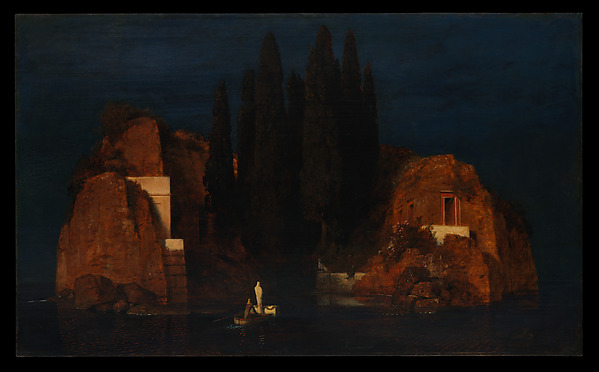
Licence: CC0 (Open Access)Island of the Dead
A small boat crosses the dark water to the island. Who is on board?
A figure wrapped in white stands behind a draped coffin. A rower sits at the back.
Böcklin, born in Basel in 1827, painted this for Marie Berna, as a memorial to her late husband. At her request he added the coffin and the shrouded figure. He painted three more versions later, and the scene inspired the composer Rachmaninoff.

ETH Library Zurich, Graphische Sammlung · Public Domain Mark · D 964 (Former Inventory No. 1909.28) · View at the museum
Licence: Public Domain MarkLa Jungfrau
Only black ink and bare paper. What shines in the night sky?
A thin crescent moon and a few stars, cut out of the black.
This is a woodcut: everything white was cut away from the wooden block. Vallotton, born in Lausanne in 1865, lived in Paris, where his black and white woodcuts made him famous. This print is at home in Zurich, in the Graphische Sammlung of ETH Zurich.

J. Paul Getty Museum · CC0 · descriptions CC BY 4.0 · 2019.3 · View at the museum
Licence: CC0 (descriptions CC BY 4.0)Spring in the Alps
Look closely at the clouds and the grass. How did Segantini paint them?
In thin threads of pure colour, laid side by side. From a distance they shimmer like mountain light.
Segantini lived and worked in Graubünden. This is Val Bregaglia, near the village of Soglio, whose church tower you can see on the right. A girl in the local costume leads two horses, a sower scatters seed, and a dog keeps watch.
Städel Museum, Frankfurt am Main · Public Domain · SG 134 · View at the museum
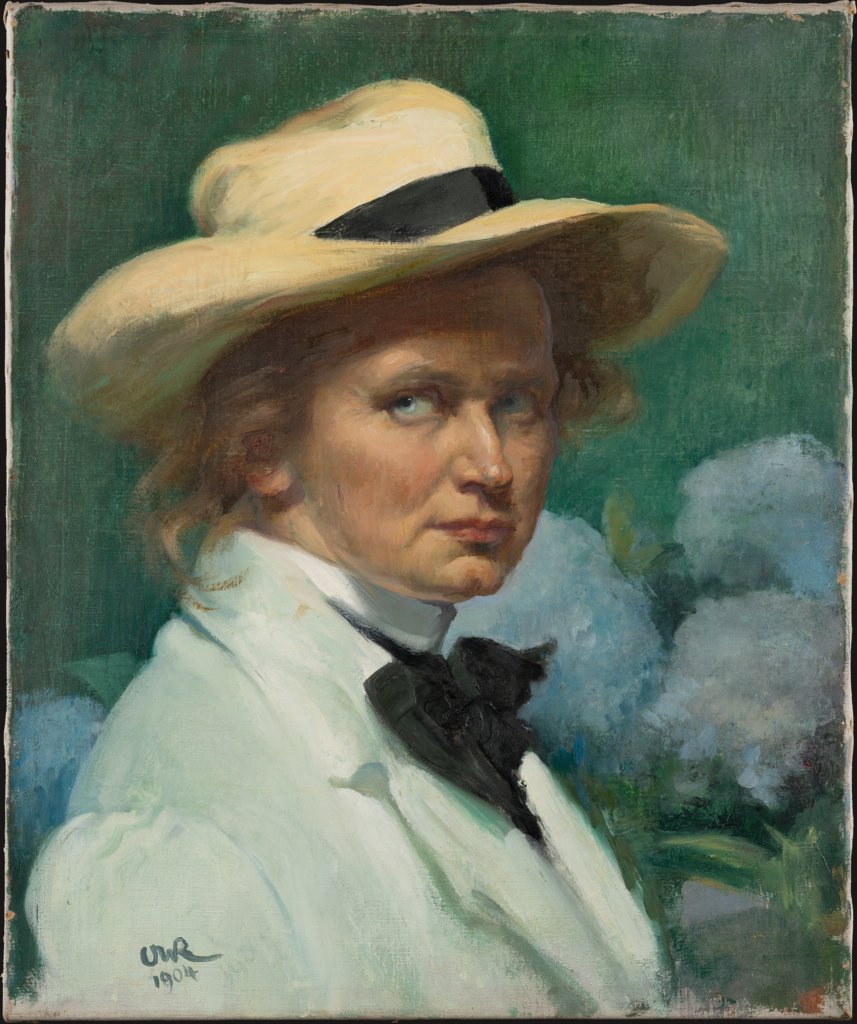
Licence: Public DomainSelf-Portrait with Hat
She looks straight back at us. Where did she sign the picture?
OWR, her initials, and the year: 1904.
Ottilie Roederstein was born in Zurich in 1859 and worked in Frankfurt. She painted more than eighty self-portraits. She showed this one, with its loose brushstrokes and light colours, at the Paris Salon the year after.
Städel Museum, Frankfurt am Main · Public Domain · SG 1229 · View at the museum
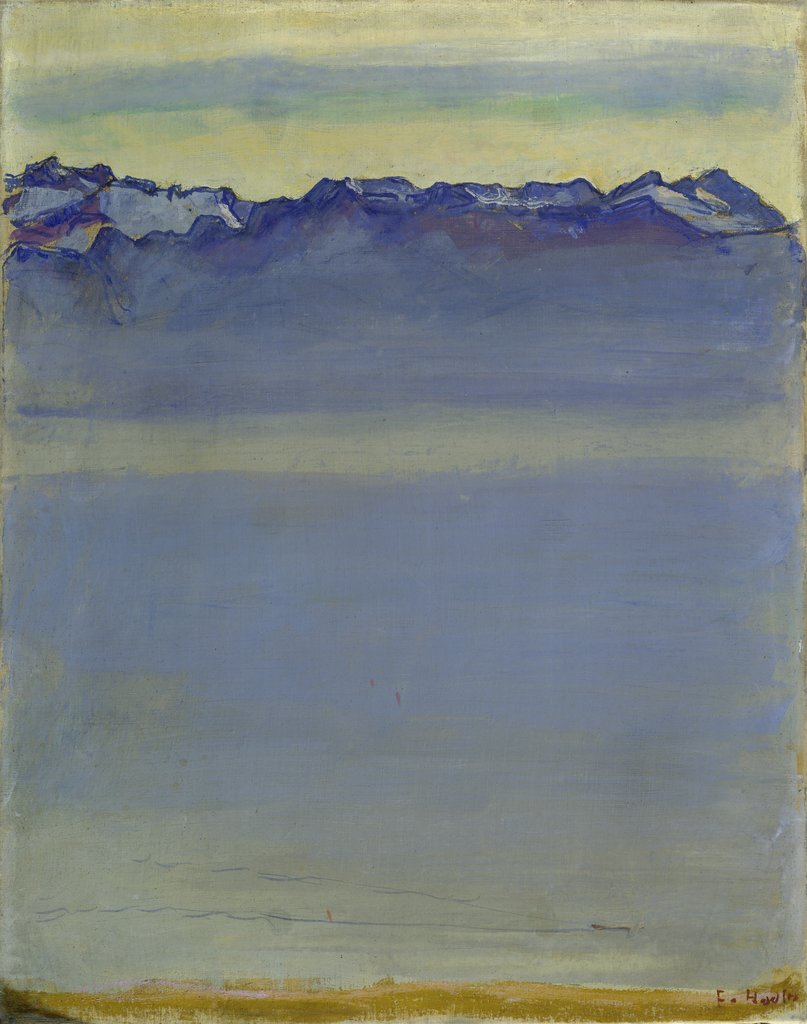
Licence: Public DomainLake Geneva with the Savoy Alps
Hodler built this landscape in bands, one above the other. How many can you count?
Shore, water, mist, more water, the blue mountains of Savoy, clouds and sky. Hodler called this repeating of forms 'parallelism'.
Hodler was born in Bern in 1853 and lived in Geneva. He painted this lake again and again, almost always without people: only water, mountains and sky.

SMK – National Gallery of Denmark · Public Domain · KKS2009-29 · View at the museum
Licence: Public DomainHaus der Firma Z (Company Z's house)
The title promises the house of 'Company Z'. Can you find the Z?
There it is: a bold black Z, among the fine lines of the house.
Paul Klee was born near Bern in 1879. In 1922 he was teaching at the Bauhaus in Germany. Along the bottom he wrote the year, the work's number and its title: he kept a careful list of everything he made.
The end of the tour
Ten artists, nine museums.
Pastel, watercolour, oil and woodcut, from 1746 to 1922. Most of these artists went abroad to work, and their works travelled further still. Paul Klee came back to Bern in 1933 and died in Switzerland in 1940.
Questions at the end
Which of these artists was born in Chur and helped to found the Royal Academy in London?
- Angelica Kauffmann (correct)
- Ottilie Roederstein
- Caspar Wolf
Angelica Kauffmann, born in Chur in 1741, was one of the founders of the Royal Academy.
What did Marie Berna ask Böcklin to add to the Island of the Dead?
- The coffin and the shrouded figure in the boat (correct)
- The tall cypress trees
- A full moon
At her request, he added the draped coffin and the shrouded figure to the boat.
How did Vallotton make the white moon in his woodcut of the Jungfrau?
- He cut it away from the wooden block (correct)
- He painted it on with white ink
- He scratched it out of the paper
In a woodcut, everything white is cut away from the block. Only what is left standing prints black.
Works from these collections
- Rijksmuseum
- National Gallery of Art
- Cleveland Museum of Art
- Yale Center for British Art
- The Metropolitan Museum of Art
- Graphische Sammlung ETH Zürich
- J. Paul Getty Museum
- Städel Museum
- SMK – National Gallery of Denmark
More tours
- Animal huntEight animals are hiding in works of art from all over the world. Can you find them?
- 1,800 years of facesTen portraits, from Roman Egypt to Van Gogh. Look for the clues: who, when, and why?
- The world around 1600What were artists making around 1600? A journey westward from Japan to Spain, in ten works, most of them made within about ten years of that date.
- Blue and whiteHow cobalt blue on white travelled from China to Turkey, Holland, Japan, Mexico, Korea and England: ten pieces, roughly in the order they were made.
- The moonA god, a hare, a bodhisattva, a crescent, a castle, a jar, geese, photographs, the sea and a city by night: the moon in ten works from around the world.
- The seaWaves, a storm, a calm, a harbour and a sunrise: eight ways of looking at the sea, across 3,000 years.
- A walk through the seasonsA calm walk from spring to winter, in eight works. Large text, a gentle voice and no hurry.
- Look closerSeven famous works, each with a small detail most people miss. Find it yourself, then hear its story.
- How old is it?Eight works from four museums. Guess when each was made before you hear the story: some are far older than they look, and two are younger.
- Albrecht DürerEleven works by the painter and printmaker from Nuremberg: a self-portrait, a rhinoceros and a magic square.
- Rembrandt, in the mirrorTen self-portraits, painted, etched and drawn: from the curly-haired young man to the old master.
- VermeerThirteen of his rare paintings, in the order he made them: quiet rooms, letters and light.
- Giovanni Battista PiranesiRome, real and imagined, in the order he etched it: ruins, squares, prisons, temples and a fireplace.
- J. M. W. TurnerStorms, fire, moonlight and golden haze, in order of date: from a Welsh castle to a storm at sea.
- Hokusai & HiroshigeThe two masters of the Japanese landscape print, side by side: ten prints, in roughly the order they were made.
- Claude MonetEleven paintings in the order he made them: the sea, Camille, grainstacks, a cathedral, London fog and his pond.
- Mary CassattFrom Seville to Paris: a theatre box, a letter, an omnibus and a boat trip. Ten paintings, prints and a pastel, in the order she made them.
- Helene SchjerfbeckFrom a soldier in the snow to a face of a few strokes: ten works, in the order she made them.
- Van GoghTen years of work, from the grey Dutch coast to the colours of the south: eleven works, in the order he made them.
- Vilhelm HammershøiGrey rooms, white doors, light on the floor and a woman seen from behind: ten works, roughly in the order he made them.
Back to the start page · all tours · press