Guided tour · One artist · Paris · Giverny · 1840–1926
Claude Monet
Eleven paintings in the order he made them: the sea, Camille, grainstacks, a cathedral, London fog and his pond.
Start this tour in AuriaanOpens the interactive flight at this tour, with a guide's voice. It needs a modern browser; the same works are shown below.
- Works
- 11
- Time
- about 17 min
- Collections
- 7
About this tour
Claude Monet painted out of doors, chasing light and weather. His Impression, Sunrise gave Impressionism its name. Here are eleven of his paintings from seven museums, in the order he made them. At every work, look first, then discover.
We begin on the Normandy coast in 1864. Monet is 23.
The 11 works
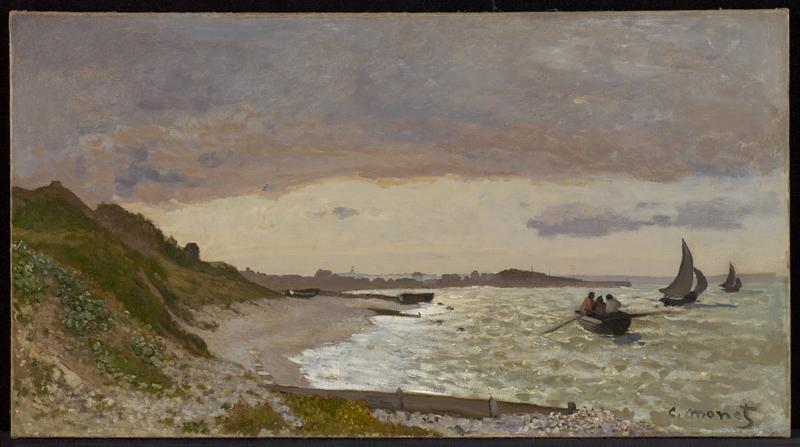
Minneapolis Institute of Art · Public Domain · 53.13 · View at the museum
Licence: Public DomainThe Seashore at Sainte-Adresse
What is out on the water?
A rowing boat with three people, and two sailing boats: each made with a few quick strokes.
Sainte-Adresse lies next to Le Havre, the port where Monet grew up. On this coast he learned to paint out of doors.

Ailsa Mellon Bruce Collection · 1970.17.41 · View at the museum
Licence: CC0 (Open Access)Bazille and Camille (Study for "Déjeuner sur l'Herbe")
How did Monet paint the man's eye?
With a single dab of pale blue paint. He is looking at the woman.
He is Monet's friend, the painter Frédéric Bazille. She is Camille Doncieux, who later married Monet. The picnic picture was never finished.

Collection of Mr. and Mrs. Paul Mellon · 1983.1.25 · View at the museum
Licence: CC0 (Open Access)The Cradle – Camille with the Artist's Son Jean
What is the baby holding?
A toy: a little white drum on an orange stick, with what may be feathers on top. A pinwheel lies across his legs.
Jean was born in August 1867. His parents were not yet married; they married three years later.

Yale University Art Gallery · Public Domain · 1998.46.1 · View at the museum
Licence: Public DomainCamille on the Beach in Trouville
Behind Camille, who is playing by the sea?
A young boy with a woman, at the water's edge as a wave rolls in.
That July, war broke out between France and Prussia. In the autumn Monet left for London.

Collection of Mr. and Mrs. Paul Mellon · 1983.1.29 · View at the museum
Licence: CC0 (Open Access)Woman with a Parasol – Madame Monet and Her Son
What is blowing across Camille's face?
A veil, fluttering in the breeze: just a few long strokes of white paint.
Monet painted her from below, against a sunny sky. Their son Jean stands behind her, in the tall grass.

Paris Musées / Petit Palais · CC0 · PPP439 · View at the museum
Licence: CC0Sunset on the Seine at Lavacourt, Winter Effect
Find the sun. Where else does it appear?
In the water below, as a reflection. Its intense colour stands out against the cold blue all around.
Lavacourt lies across the Seine from Vétheuil, where Monet lived from 1878 to 1881.
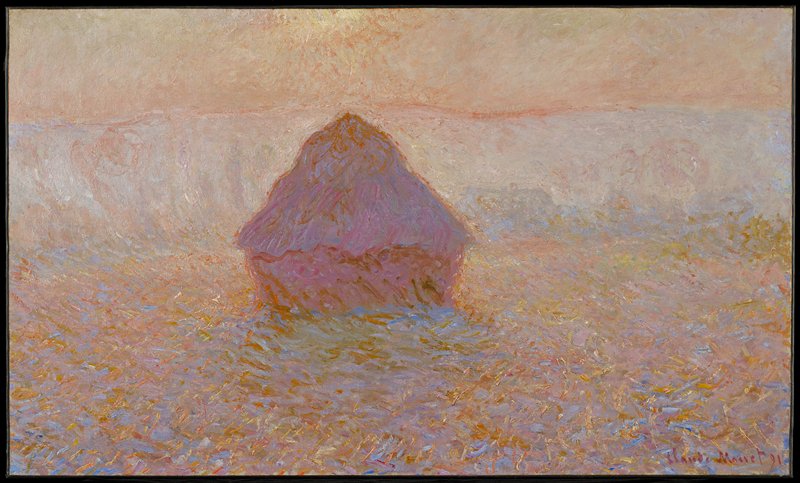
Minneapolis Institute of Art · Public Domain · 93.20 · View at the museum
Licence: Public DomainGrainstack, Sun in the Mist
What does the light do around the grainstack?
It forms a glowing halo. This is an autumn dawn, as the sun burns off the rising mist.
Monet painted these stacks near his house again and again, in changing light. Up close: a patchwork of broken strokes.

J. Paul Getty Museum · CC0 · descriptions CC BY 4.0 · 2001.33 · View at the museum
Licence: CC0 (descriptions CC BY 4.0)The Portal of Rouen Cathedral in Morning Light
Is the stone of the portal smooth?
Not at all. The paint is as thick and crusty as the old stone itself.
He made thirty views of the cathedral. This one he began in a dressmaker's shop opposite. "Everything changes, even stone," he wrote.

Gift of Victoria Nebeker Coberly, in memory of her son John W. Mudd, and Walter H. and Leonore Annenberg · 1992.9.1 · View at the museum
Licence: CC0 (Open Access)The Japanese Footbridge
What floats on the pond under the bridge?
Water lilies, pink and yellow, in bands that zigzag into the distance.
Monet designed this garden himself. He signed the painting in the lower right corner: "Claude Monet 99".

Princeton University Art Museum · Public Domain · y1979-54 · View at the museum
Licence: Public DomainThe Houses of Parliament, Seagulls
What is flying over the river?
Seagulls: a few quick strokes against the glowing fog.
Monet painted Parliament from St Thomas' Hospital, across the Thames, and finished the pictures at home in Giverny.
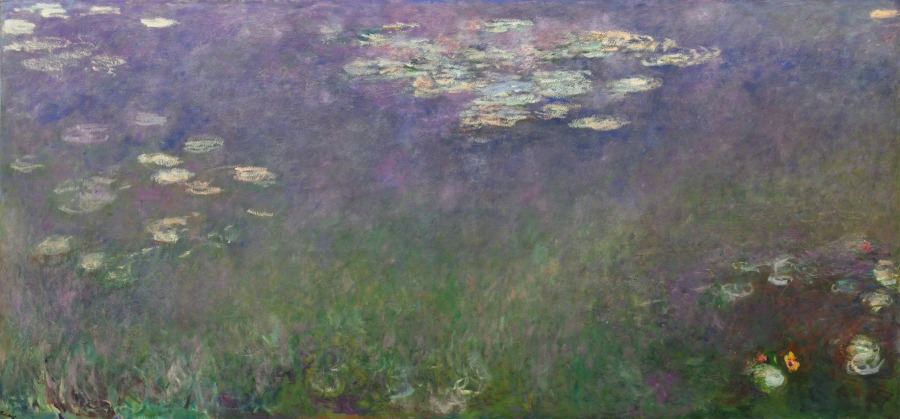
John L. Severance Fund and an anonymous gift · 1960.81 · View at the museum
Licence: CC0 (Open Access)Water Lilies (Agapanthus)
Find the flowers in bloom.
A few blossoms glow among the leaves. There is no bank and no horizon: only water.
For his last thirty years, Monet painted the garden he had designed at Giverny. On this huge canvas, the pond seems endless.
The end of the tour
The same place, never the same light.
Monet painted the same grainstack, the same cathedral and the same pond again and again, because the light was never the same twice. He died at Giverny in 1926, aged 86.
Questions at the end
Why did Monet paint the same grainstack or cathedral so many times?
- To catch the changing light (correct)
- Because buyers wanted copies
- To practise for an exam
Each canvas catches a different moment: another hour, another season, other weather.
Where did Monet make his water garden with the Japanese bridge?
- Giverny (correct)
- Le Havre
- London
He settled at Giverny in 1883 and painted his pond there until the end of his life.
Who is the woman with the parasol?
- Camille, Monet's first wife (correct)
- A famous actress
- Monet's sister
Camille Doncieux posed for Monet many times. They married in 1870; she died in 1879.
Works from these collections
- Minneapolis Institute of Art
- National Gallery of Art
- Yale University Art Gallery
- Paris Musées
- J. Paul Getty Museum
- Princeton University Art Museum
- Cleveland Museum of Art
More tours
- Artists of Switzerland in the world's museumsTen artists born or at home in Switzerland, from Liotard to Klee, in nine museums around the world.
- Animal huntEight animals are hiding in works of art from all over the world. Can you find them?
- 1,800 years of facesTen portraits, from Roman Egypt to Van Gogh. Look for the clues: who, when, and why?
- The world around 1600What were artists making around 1600? A journey westward from Japan to Spain, in ten works, most of them made within about ten years of that date.
- Blue and whiteHow cobalt blue on white travelled from China to Turkey, Holland, Japan, Mexico, Korea and England: ten pieces, roughly in the order they were made.
- The moonA god, a hare, a bodhisattva, a crescent, a castle, a jar, geese, photographs, the sea and a city by night: the moon in ten works from around the world.
- The seaWaves, a storm, a calm, a harbour and a sunrise: eight ways of looking at the sea, across 3,000 years.
- A walk through the seasonsA calm walk from spring to winter, in eight works. Large text, a gentle voice and no hurry.
- Look closerSeven famous works, each with a small detail most people miss. Find it yourself, then hear its story.
- How old is it?Eight works from four museums. Guess when each was made before you hear the story: some are far older than they look, and two are younger.
- Albrecht DürerEleven works by the painter and printmaker from Nuremberg: a self-portrait, a rhinoceros and a magic square.
- Rembrandt, in the mirrorTen self-portraits, painted, etched and drawn: from the curly-haired young man to the old master.
- VermeerThirteen of his rare paintings, in the order he made them: quiet rooms, letters and light.
- Giovanni Battista PiranesiRome, real and imagined, in the order he etched it: ruins, squares, prisons, temples and a fireplace.
- J. M. W. TurnerStorms, fire, moonlight and golden haze, in order of date: from a Welsh castle to a storm at sea.
- Hokusai & HiroshigeThe two masters of the Japanese landscape print, side by side: ten prints, in roughly the order they were made.
- Mary CassattFrom Seville to Paris: a theatre box, a letter, an omnibus and a boat trip. Ten paintings, prints and a pastel, in the order she made them.
- Helene SchjerfbeckFrom a soldier in the snow to a face of a few strokes: ten works, in the order she made them.
- Van GoghTen years of work, from the grey Dutch coast to the colours of the south: eleven works, in the order he made them.
- Vilhelm HammershøiGrey rooms, white doors, light on the floor and a woman seen from behind: ten works, roughly in the order he made them.
Back to the start page · all tours · press