Guided tour · One artist · 1853–1890
Van Gogh
Ten years of work, from the grey Dutch coast to the colours of the south: eleven works, in the order he made them.
Start this tour in AuriaanOpens the interactive flight at this tour, with a guide's voice. It needs a modern browser; the same works are shown below.
- Works
- 11
- Time
- about 17 min
- Collections
- 5
About this tour
Vincent van Gogh worked as an artist for only about ten years, until his death in 1890. Here are eleven of his works from five museums, in the order he made them: from the dark tones of Holland to the light and colour of France. At every work, look first, then discover.
We begin in 1882, near The Hague, where Van Gogh has been working for just six months.
The 11 works

J. Paul Getty Museum · CC0 · descriptions CC BY 4.0 · 98.GC.2 · View at the museum
Licence: CC0 (descriptions CC BY 4.0)Bleachery at Scheveningen
Something white lies all over this field. What could it be?
Linen, laid out in the sun to bleach. Women work among it, and more of it blows on the fence.
“Right on the spot, washed in at one sitting,” he wrote. He probably drew on the other side first, then turned the sheet over and painted this.

Rosenwald Collection · 1951.10.33 · View at the museum
Licence: CC0 (Open Access)The Potato Eaters
Only one thing lights this room. Can you find it?
A single oil lamp, hanging over the table. The family eats by its light.
He wanted to show people who dug the earth with the same hands they eat with. In his famous painting of it, the scene is the other way round.
Bequest of Miss Adelaide Milton de Groot (1876-1967), 1967 · 67.187.70a · View at the museum
Licence: CC0 (Open Access)Self-Portrait with a Straw Hat
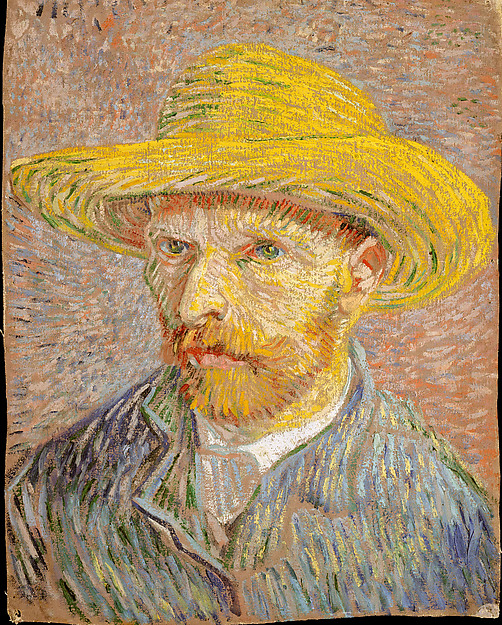
Look at his beard. How many colours can you find in it?
Orange, red and yellow, with touches of green: short strokes of colour, side by side.
To save money, he painted it on the back of an older canvas. On the other side is a woman peeling potatoes, painted in Nuenen in 1885.

Yale University Art Gallery · Public Domain · 1958.59 · View at the museum
Licence: Public DomainSquare Saint-Pierre, Paris
Look at the path and the grass. How are they painted?
With small dots and dashes of colour, side by side: the pointillist style of the young painters he met in Paris.
A woman in a red top strolls along the path. In Paris he tried out the newest ideas about colour.
The Mr. and Mrs. Henry Ittleson Jr. Purchase Fund, 1956 · 56.13 · View at the museum
Licence: CC0 (Open Access)The Flowering Orchard
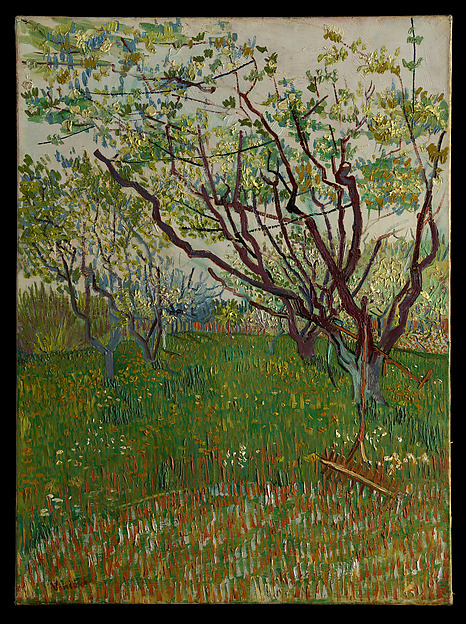
What season is it?
Spring: the fruit trees are in blossom.
In his first spring in Arles he painted a whole series of orchards in flower. He had hoped to find in the south the bright world of the Japanese prints he loved.

Chester Dale Collection · 1963.10.151 · View at the museum
Licence: CC0 (Open Access)La Mousmé
What is she holding in her hand?
A sprig of flowering oleander.
‘Mousmé’ is a Japanese word for a young woman. Van Gogh found it in a French novel set in Japan.

J. Paul Getty Museum · CC0 · descriptions CC BY 4.0 · 85.GA.299 · View at the museum
Licence: CC0 (descriptions CC BY 4.0)Portrait of Joseph Roulin
Who is this man? Look for a clue.
His cap says POSTES: Joseph Roulin was a postal worker in Arles.
Van Gogh called him “so wise and so full of feeling”. Thick reed-pen lines and nervous fine ones make the whole drawing vibrate.

Yale University Art Gallery · Public Domain · 1961.18.34 · View at the museum
Licence: Public DomainThe Night Café
Look at the lamps. How did he paint their light?
As rings of short yellow and orange strokes, glowing against the red wall and the green ceiling.
He wrote that he wanted to express “the terrible passions of humanity” with red and green. He stayed up three nights to paint it.
Purchase, The Annenberg Foundation Gift, 1993 · 1993.132 · View at the museum
Licence: CC0 (Open Access)Wheat Field with Cypresses
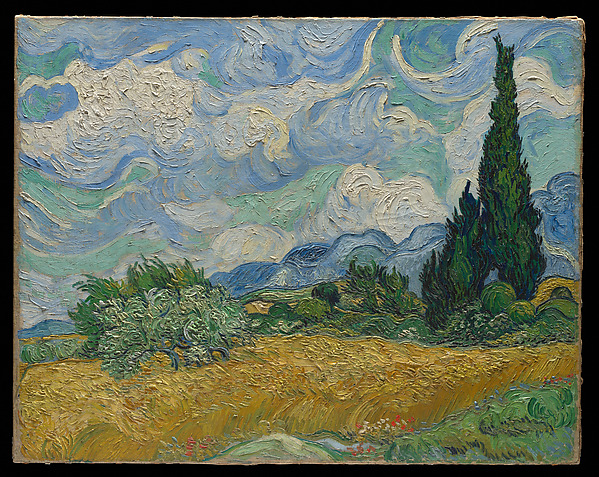
What is the tall dark shape on the right?
Cypress trees, rising like a dark green flame above the ripe wheat.
He wrote that cypresses were as beautiful in line and proportion as an Egyptian obelisk.

Gift of the Hanna Fund · 1947.209 · View at the museum
Licence: CC0 (Open Access)The Large Plane Trees (Road Menders at Saint-Rémy)
What is happening in this street?
The road is being repaired: there are heaps of sand and stones everywhere.
He described it to his brother Theo: “heaps of sand, stones, and the gigantic trunks—the leaves yellowing”.

Collection of Mr. and Mrs. Paul Mellon · 2013.122.1 · View at the museum
Licence: CC0 (Open Access)Green Wheat Fields, Auvers
Is the wind blowing in this field?
Yes: the young wheat bends in waves of curling strokes, and the clouds swirl above it.
He painted it in Auvers, in the last months of his life. Van Gogh died there in July 1890, aged 37.
The end of the tour
Ten years, more than 800 paintings.
From the grey Dutch coast to the wheat fields of Auvers. In his lifetime he sold very little; today his works are among the best loved in the world.
Questions at the end
Where did Van Gogh go in 1888 to find light and colour?
- Arles, in the south of France (correct)
- London
- Amsterdam
In February 1888 he left Paris for Arles, in Provence.
What is on the other side of his Self-Portrait with a Straw Hat?
- A woman peeling potatoes (correct)
- A map of Paris
- A letter to his brother
To save canvas, he painted the self-portrait on the back of a painting he had made in Nuenen.
Which word did Van Gogh borrow from a novel set in Japan?
- Mousmé (correct)
- Arlésienne
- Berceuse
A mousmé is a Japanese word for a young woman. He gave it to a young woman from Arles.
Works from these collections
- J. Paul Getty Museum
- National Gallery of Art
- The Metropolitan Museum of Art
- Yale University Art Gallery
- Cleveland Museum of Art
More tours
- Artists of Switzerland in the world's museumsTen artists born or at home in Switzerland, from Liotard to Klee, in nine museums around the world.
- Animal huntEight animals are hiding in works of art from all over the world. Can you find them?
- 1,800 years of facesTen portraits, from Roman Egypt to Van Gogh. Look for the clues: who, when, and why?
- The world around 1600What were artists making around 1600? A journey westward from Japan to Spain, in ten works, most of them made within about ten years of that date.
- Blue and whiteHow cobalt blue on white travelled from China to Turkey, Holland, Japan, Mexico, Korea and England: ten pieces, roughly in the order they were made.
- The moonA god, a hare, a bodhisattva, a crescent, a castle, a jar, geese, photographs, the sea and a city by night: the moon in ten works from around the world.
- The seaWaves, a storm, a calm, a harbour and a sunrise: eight ways of looking at the sea, across 3,000 years.
- A walk through the seasonsA calm walk from spring to winter, in eight works. Large text, a gentle voice and no hurry.
- Look closerSeven famous works, each with a small detail most people miss. Find it yourself, then hear its story.
- How old is it?Eight works from four museums. Guess when each was made before you hear the story: some are far older than they look, and two are younger.
- Albrecht DürerEleven works by the painter and printmaker from Nuremberg: a self-portrait, a rhinoceros and a magic square.
- Rembrandt, in the mirrorTen self-portraits, painted, etched and drawn: from the curly-haired young man to the old master.
- VermeerThirteen of his rare paintings, in the order he made them: quiet rooms, letters and light.
- Giovanni Battista PiranesiRome, real and imagined, in the order he etched it: ruins, squares, prisons, temples and a fireplace.
- J. M. W. TurnerStorms, fire, moonlight and golden haze, in order of date: from a Welsh castle to a storm at sea.
- Hokusai & HiroshigeThe two masters of the Japanese landscape print, side by side: ten prints, in roughly the order they were made.
- Claude MonetEleven paintings in the order he made them: the sea, Camille, grainstacks, a cathedral, London fog and his pond.
- Mary CassattFrom Seville to Paris: a theatre box, a letter, an omnibus and a boat trip. Ten paintings, prints and a pastel, in the order she made them.
- Helene SchjerfbeckFrom a soldier in the snow to a face of a few strokes: ten works, in the order she made them.
- Vilhelm HammershøiGrey rooms, white doors, light on the floor and a woman seen from behind: ten works, roughly in the order he made them.
Back to the start page · all tours · press