Guided tour · Guess first · Guess first
How old is it?
Eight works from four museums. Guess when each was made before you hear the story: some are far older than they look, and two are younger.
Start this tour in AuriaanOpens the interactive flight at this tour, with a guide's voice. It needs a modern browser; the same works are shown below.
- Works
- 8
- Time
- about 9 min
- Collections
- 4
About this tour
At every work, choose when you think it was made, then hear the answer. Some of these look new but are thousands of years old. Ready?
We begin on an island in the Aegean Sea.
The 8 works

Gift of Christos G. Bastis, 1968 · 68.148 · View at the museum
Licence: CC0 (Open Access)Marble female figure
This figure looks almost modern. When do you think it was made?
About 4,500 years ago, on the Cycladic islands in the Aegean Sea. Figures like this were carved in marble, and many once had painted details. Their clean, simple shapes later fascinated modern sculptors.

Rogers Fund, 1914 · JP10 · View at the museum
Licence: CC0 (Open Access)Under the Wave off Kanagawa (The Great Wave)
Perhaps the most famous wave in art. When was this print made?
Around 1830 to 1832, by Katsushika Hokusai in Edo, today's Tokyo. It is a colour woodblock print from his series Thirty-six Views of Mount Fuji: the small mountain sits under the wave. Prints like this were made in their thousands and sold cheaply.

Gift of Edward S. Harkness, 1917 · 17.9.1 · View at the museum
Licence: CC0 (Open Access)Hippopotamus ("William")
This blue hippopotamus could be a toy from a shop today. How old is it?
About 3,900 years old. It was made in Egypt in the Middle Kingdom, of blue faience, and the plants painted on its body show the marshes where hippos lived. At the Met it is known as William.

W.G. Russell Allen, Ailsa Mellon Bruce, Lessing J. Rosenwald, and Pepita Milmore Funds · 1976.35.5 · View at the museum
Licence: CC0 (Open Access)The Drawbridge
Giant bridges, stairs and chains: it could be a film set. When was it made?
Around 1750, in Rome. Giovanni Battista Piranesi etched it for his Imaginary Prisons, a series of vast spaces that exist only on paper. Some eleven years later he reworked the plates and made them darker still.

Munsey Fund, 1931 · 24.72.2a–c · View at the museum
Licence: CC0 (Open Access)Ritual Wine Container (Yu)
A bronze container for wine, covered with raised patterns. When was it cast?
In the late 11th century BC, more than 3,000 years ago. In ancient China, bronze vessels like this held wine for ceremonies honouring the ancestors. The green comes from centuries of age.

SMK – National Gallery of Denmark · Public Domain · KMS3696 · View at the museum
Licence: Public DomainInterior in Strandgade, Sunlight on the Floor
Sunlight on the floor of a quiet room. It looks like an old Dutch painting. When was it painted?
In 1901, in Copenhagen. Vilhelm Hammershøi painted the rooms of his own flat in Strandgade again and again, often empty or with one figure. He chose his homes with care: "I personally prefer the Old; old buildings, old furniture," he said.
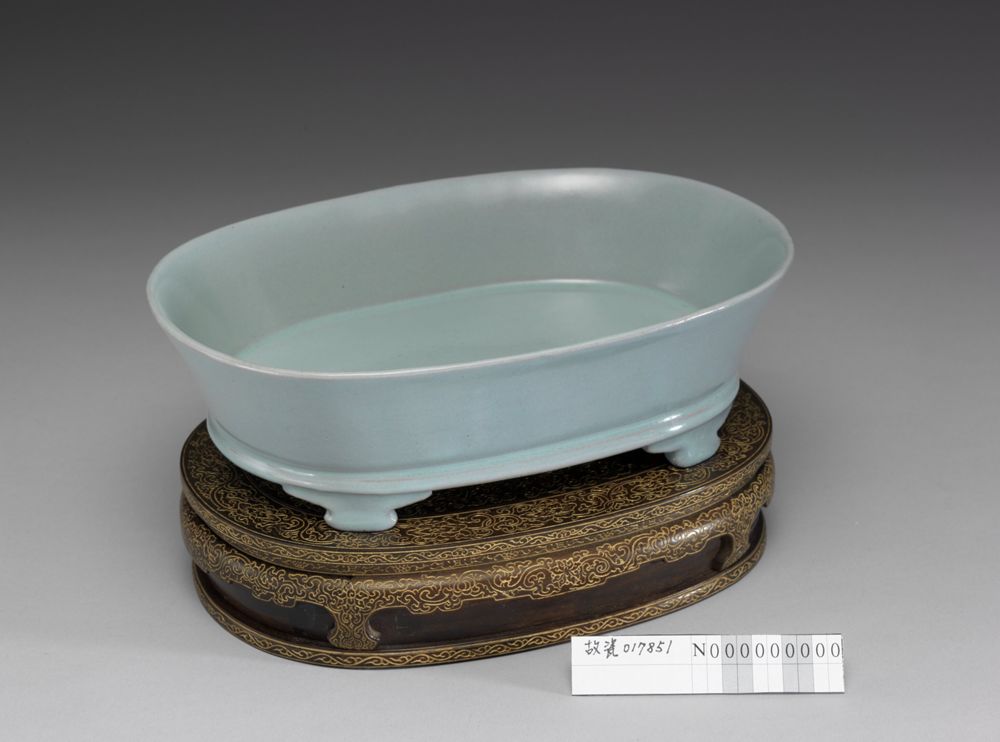
National Palace Museum, Taipei · CC BY 4.0 · K1B017851N000000000PAA · View at the museum
Licence: CC BY 4.0Narcissus basin with bluish-green glaze, Ru ware
A simple oval dish in soft blue-green. It could be modern design. When was it made?
Around 1100, under China's Northern Song dynasty. Ru ware was made for the imperial court for only a few decades, and very few pieces survive. All its beauty lies in its shape and its soft, even glaze.
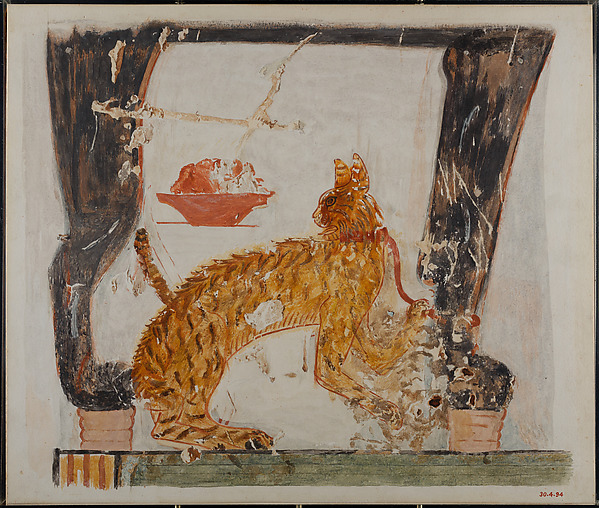
Rogers Fund, 1930 · 30.4.94 · View at the museum
Licence: CC0 (Open Access)Cat Seated under a Chair
Last one. This cat comes from an Egyptian tomb. When was this picture painted?
In 1916! It is a careful copy, painted by Hugh R. Hopgood after a wall painting in a tomb from about 1500 BC. Copies like this were made to record the old paintings faithfully.
The end of the tour
From a marble figure about 4,500 years old to a copy painted in 1916: how old a work looks says little about how old it is.
Works from these collections
- The Metropolitan Museum of Art
- National Gallery of Art
- SMK – National Gallery of Denmark
- National Palace Museum
More tours
- Artists of Switzerland in the world's museumsTen artists born or at home in Switzerland, from Liotard to Klee, in nine museums around the world.
- Animal huntEight animals are hiding in works of art from all over the world. Can you find them?
- 1,800 years of facesTen portraits, from Roman Egypt to Van Gogh. Look for the clues: who, when, and why?
- The world around 1600What were artists making around 1600? A journey westward from Japan to Spain, in ten works, most of them made within about ten years of that date.
- Blue and whiteHow cobalt blue on white travelled from China to Turkey, Holland, Japan, Mexico, Korea and England: ten pieces, roughly in the order they were made.
- The moonA god, a hare, a bodhisattva, a crescent, a castle, a jar, geese, photographs, the sea and a city by night: the moon in ten works from around the world.
- The seaWaves, a storm, a calm, a harbour and a sunrise: eight ways of looking at the sea, across 3,000 years.
- A walk through the seasonsA calm walk from spring to winter, in eight works. Large text, a gentle voice and no hurry.
- Look closerSeven famous works, each with a small detail most people miss. Find it yourself, then hear its story.
- Albrecht DürerEleven works by the painter and printmaker from Nuremberg: a self-portrait, a rhinoceros and a magic square.
- Rembrandt, in the mirrorTen self-portraits, painted, etched and drawn: from the curly-haired young man to the old master.
- VermeerThirteen of his rare paintings, in the order he made them: quiet rooms, letters and light.
- Giovanni Battista PiranesiRome, real and imagined, in the order he etched it: ruins, squares, prisons, temples and a fireplace.
- J. M. W. TurnerStorms, fire, moonlight and golden haze, in order of date: from a Welsh castle to a storm at sea.
- Hokusai & HiroshigeThe two masters of the Japanese landscape print, side by side: ten prints, in roughly the order they were made.
- Claude MonetEleven paintings in the order he made them: the sea, Camille, grainstacks, a cathedral, London fog and his pond.
- Mary CassattFrom Seville to Paris: a theatre box, a letter, an omnibus and a boat trip. Ten paintings, prints and a pastel, in the order she made them.
- Helene SchjerfbeckFrom a soldier in the snow to a face of a few strokes: ten works, in the order she made them.
- Van GoghTen years of work, from the grey Dutch coast to the colours of the south: eleven works, in the order he made them.
- Vilhelm HammershøiGrey rooms, white doors, light on the floor and a woman seen from behind: ten works, roughly in the order he made them.
Back to the start page · all tours · press