Guided tour · One artist · Delft · 1632–1675
Vermeer
Thirteen of his rare paintings, in the order he made them: quiet rooms, letters and light.
Start this tour in AuriaanOpens the interactive flight at this tour, with a guide's voice. It needs a modern browser; the same works are shown below.
- Works
- 13
- Time
- about 20 min
- Collections
- 4
About this tour
Johannes Vermeer lived and worked in Delft. Only about 35 of his paintings are known, and thirteen of them are in the open collections of four museums. Here they are in the order he painted them. At every work, look first, then discover.
We begin in Delft, around 1656. Vermeer is in his twenties.
The 13 works
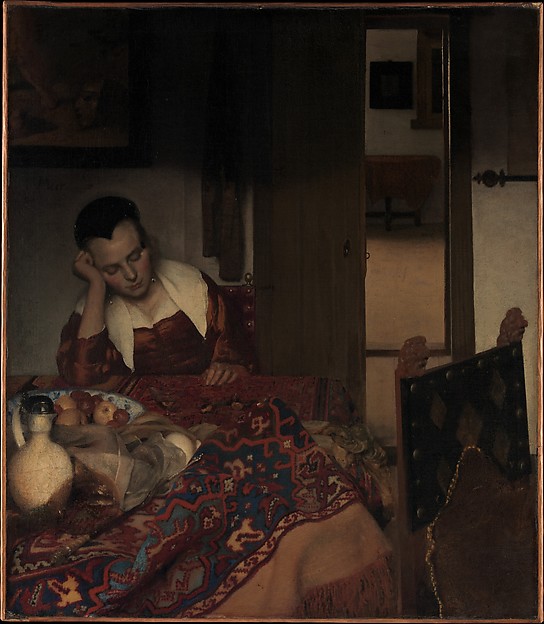
Bequest of Benjamin Altman, 1913 · 14.40.611 · View at the museum
Licence: CC0 (Open Access)A Maid Asleep
Look through the open door. Who is in the room behind?
Nobody. But X-rays indicate that Vermeer first painted a man standing in the doorway. He painted him out.
What is left is a quiet scene: a young woman dozing at a table. Is she asleep, or dreaming? Vermeer leaves it open.

Rijksmuseum, Amsterdam · Public Domain · SK-A-2860 · View at the museum
Licence: Public DomainThe Little Street
This street seems empty at first. Can you find the people?
A woman sews in a doorway, two children kneel on the pavement, and in the passage a woman bends over a washtub.
Ordinary houses were an unusual subject. This is the Vlamingstraat in Delft: Vermeer's aunt lived in the house on the right.

Rijksmuseum, Amsterdam · Public Domain · SK-A-2344 · View at the museum
Licence: Public DomainThe Milkmaid
Only one thing moves in this kitchen. What is it?
The thin stream of milk. Everything else is still.
Look at the bread and the other objects: Vermeer made the light play over them with hundreds of small dots of colour.
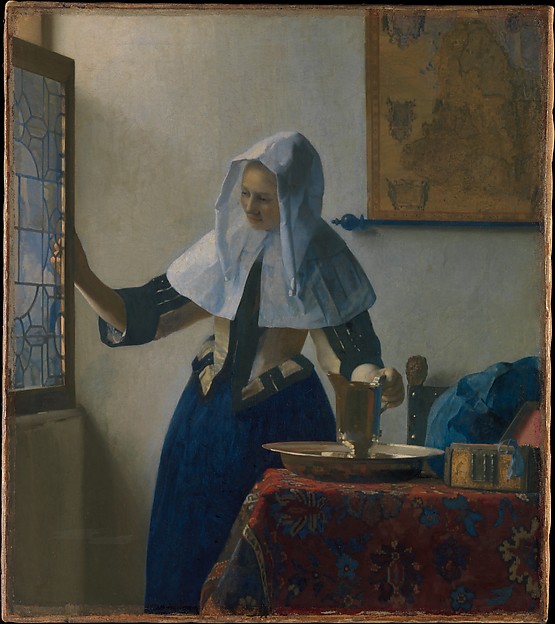
Marquand Collection, Gift of Henry G. Marquand, 1889 · 89.15.21 · View at the museum
Licence: CC0 (Open Access)Young Woman with a Water Pitcher
Look at the gilded silver basin on the table. What can you see in it?
The colours of the carpet, reflected in the silver.
She opens the window with one hand and holds the pitcher with the other: a moment in the middle of a movement. Her white linen hood is painted in shades of blue.
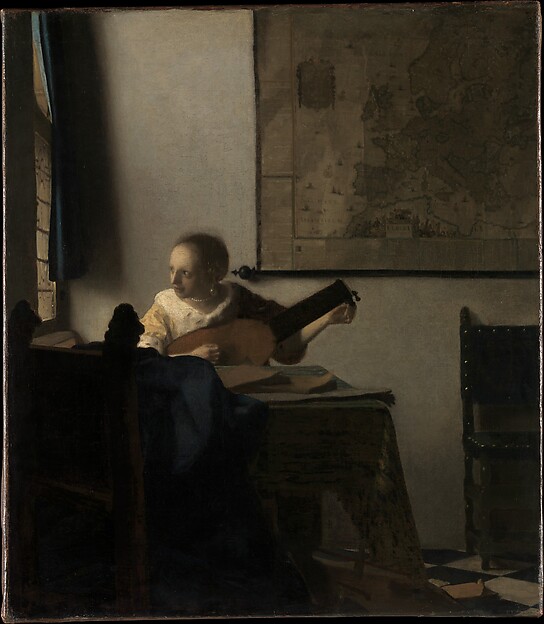
Bequest of Collis P. Huntington, 1900 · 25.110.24 · View at the museum
Licence: CC0 (Open Access)Young Woman with a Lute
She is tuning her lute. But where is she looking?
Out of the window, while her fingers turn a tuning peg. Is she waiting for someone?
Behind her hangs a large map. In Vermeer's quiet rooms, the wide world is often there, on the wall.

Rijksmuseum, Amsterdam · Public Domain · SK-C-251 · View at the museum
Licence: Public DomainWoman Reading a Letter
What colour are the shadows on the wall?
Light blue, not grey or brown. Vermeer looked at light very precisely.
She is still wearing her blue night jacket. Its glowing blue was made from lapis lazuli, a semi-precious stone.

Widener Collection · 1942.9.97 · View at the museum
Licence: CC0 (Open Access)Woman Holding a Balance
What is she weighing?
Nothing: the pans of the balance are empty. She stands as if waiting for them to come to rest, in a moment of perfect balance.
Behind her hangs a painting of the Last Judgement, when souls are weighed. Pearls and gold lie on the table.

Gift of Harry Waldron Havemeyer and Horace Havemeyer, Jr., in memory of their father, Horace Havemeyer · 1962.10.1 · View at the museum
Licence: CC0 (Open Access)A Lady Writing
She looks straight at us. What hangs from her ears?
Large pearl earrings: a few touches of white and grey, and they shine.
Her yellow jacket with white fur appears in several of Vermeer's paintings. A jacket like it is listed in the inventory of his house after his death.

Gift of Mr. and Mrs. Charles Wrightsman, in memory of Theodore Rousseau Jr., 1979 · 1979.396.1 · View at the museum
Licence: CC0 (Open Access)Study of a Young Woman
Who is she?
No one knows. Most likely it is a 'tronie': not a commissioned portrait, but a portrayal of an intriguing person, often in fanciful costume.
Like the famous Girl with a Pearl Earring in The Hague, she turns towards us out of a dark background.

Andrew W. Mellon Collection · 1937.1.53 · View at the museum
Licence: CC0 (Open Access)Girl with the Red Hat
Two lions are hiding in this painting. Can you find them?
The carved lion heads of a chair. Their highlights are soft, blurred dots of light, like a photograph slightly out of focus.
That is why some think Vermeer used a camera obscura, a box with a lens. The painting is only 23 by 18 centimetres, on a wooden panel.
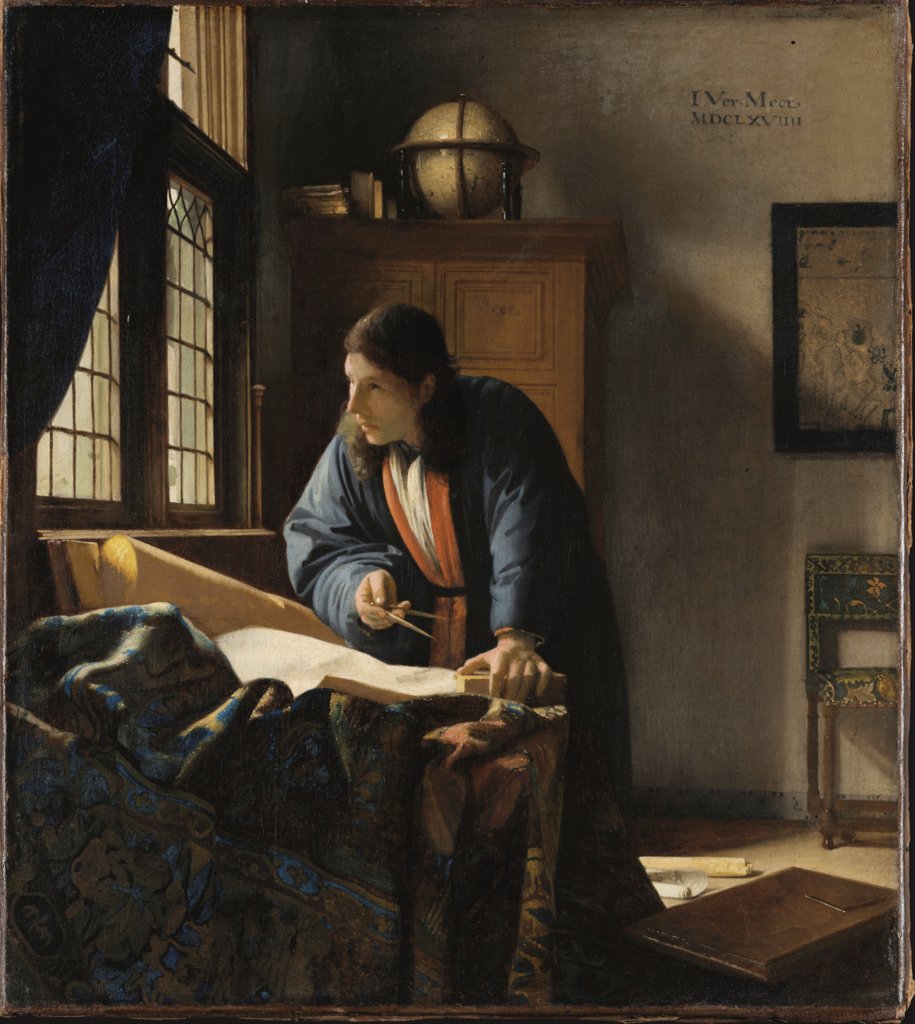
Städel Museum, Frankfurt am Main · Public Domain · 1149 · View at the museum
Licence: Public DomainThe Geographer
Vermeer dated very few of his paintings. Can you find the date on this one?
Top right, under his name: MDCLXVIIII. That is 1669, in Roman numerals.
The man has looked up from his map, dividers in hand, towards the light. On the cupboard stands a globe of the earth.

Rijksmuseum, Amsterdam · Public Domain · SK-A-1595 · View at the museum
Licence: Public DomainThe Love Letter
Look at the paintings on the wall behind the two women. What could they say about the letter?
A ship at sea. In Vermeer's time, love was often compared to the sea, and the lover to a ship.
We look in through a doorway. The maid has just handed her mistress a letter, and she looks up, expectantly.
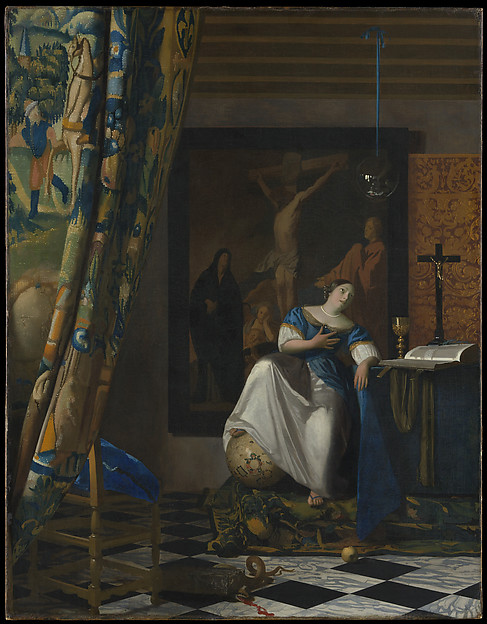
The Friedsam Collection, Bequest of Michael Friedsam, 1931 · 32.100.18 · View at the museum
Licence: CC0 (Open Access)Allegory of the Catholic Faith
Something hangs from the ceiling. What can you see in it?
A glass ball that reflects the room. Unlike the solid globe at her feet, this delicate glass may reflect Vermeer's vision of Heaven.
The woman stands for the Catholic Church, her foot on the world. Vermeer had become a Catholic before he married.
The end of the tour
Thirteen of about thirty-five.
Quiet rooms, light from a window on the left, and people caught in a moment. Vermeer died in Delft in 1675, only 43 years old. He was almost forgotten for two centuries, until a French critic rediscovered him in the 1860s.
Questions at the end
What do almost all of these rooms have in common?
- Light from a window on the left (correct)
- A sleeping cat
- A fire in the fireplace
Again and again, the light falls in from a window on the left.
What did X-rays reveal under A Maid Asleep?
- A man in the doorway, painted out (correct)
- A second maid
- A hidden self-portrait
Vermeer first painted a man standing in the doorway, then painted him out.
How many paintings by Vermeer are known today?
- About 35 (correct)
- About 350
- About 3,500
About 35. He worked slowly, and few of his paintings survive.
Works from these collections
More tours
- Artists of Switzerland in the world's museumsTen artists born or at home in Switzerland, from Liotard to Klee, in nine museums around the world.
- Animal huntEight animals are hiding in works of art from all over the world. Can you find them?
- 1,800 years of facesTen portraits, from Roman Egypt to Van Gogh. Look for the clues: who, when, and why?
- The world around 1600What were artists making around 1600? A journey westward from Japan to Spain, in ten works, most of them made within about ten years of that date.
- Blue and whiteHow cobalt blue on white travelled from China to Turkey, Holland, Japan, Mexico, Korea and England: ten pieces, roughly in the order they were made.
- The moonA god, a hare, a bodhisattva, a crescent, a castle, a jar, geese, photographs, the sea and a city by night: the moon in ten works from around the world.
- The seaWaves, a storm, a calm, a harbour and a sunrise: eight ways of looking at the sea, across 3,000 years.
- A walk through the seasonsA calm walk from spring to winter, in eight works. Large text, a gentle voice and no hurry.
- Look closerSeven famous works, each with a small detail most people miss. Find it yourself, then hear its story.
- How old is it?Eight works from four museums. Guess when each was made before you hear the story: some are far older than they look, and two are younger.
- Albrecht DürerEleven works by the painter and printmaker from Nuremberg: a self-portrait, a rhinoceros and a magic square.
- Rembrandt, in the mirrorTen self-portraits, painted, etched and drawn: from the curly-haired young man to the old master.
- Giovanni Battista PiranesiRome, real and imagined, in the order he etched it: ruins, squares, prisons, temples and a fireplace.
- J. M. W. TurnerStorms, fire, moonlight and golden haze, in order of date: from a Welsh castle to a storm at sea.
- Hokusai & HiroshigeThe two masters of the Japanese landscape print, side by side: ten prints, in roughly the order they were made.
- Claude MonetEleven paintings in the order he made them: the sea, Camille, grainstacks, a cathedral, London fog and his pond.
- Mary CassattFrom Seville to Paris: a theatre box, a letter, an omnibus and a boat trip. Ten paintings, prints and a pastel, in the order she made them.
- Helene SchjerfbeckFrom a soldier in the snow to a face of a few strokes: ten works, in the order she made them.
- Van GoghTen years of work, from the grey Dutch coast to the colours of the south: eleven works, in the order he made them.
- Vilhelm HammershøiGrey rooms, white doors, light on the floor and a woman seen from behind: ten works, roughly in the order he made them.
Back to the start page · all tours · press