Guided tour · For everyone · Around the world · from ancient Egypt to 1914
The moon
A god, a hare, a bodhisattva, a crescent, a castle, a jar, geese, photographs, the sea and a city by night: the moon in ten works from around the world.
Start this tour in AuriaanOpens the interactive flight at this tour, with a guide's voice. It needs a modern browser; the same works are shown below.
- Works
- 10
- Time
- about 15 min
- Collections
- 8
About this tour
Everyone on Earth sees the same moon, but not everyone sees the same thing in it. Here are ten works from eight museums, from ancient Egypt to the twentieth century, in the order they were made. At every work, look first, then discover.
We begin in Egypt, with a lamp made of Nile clay.
The 10 works
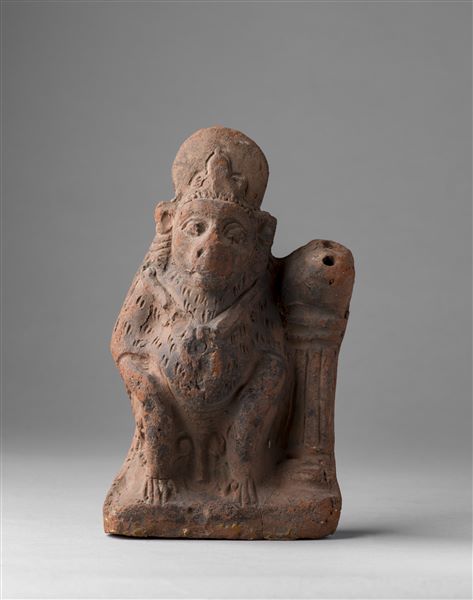
Museo Egizio, Turin · CC0 · Cat. 7236 · View at the museum
Licence: CC0Lamp in the shape of the Egyptian god Thoth as a baboon with the moon disk on his head
This little clay lamp is a god in the shape of a baboon. What does he wear on his head?
The moon: a round disc. Thoth, the god of writing and wisdom, was also a god of the moon.
The Egyptians showed Thoth as a baboon or as an ibis, and linked him with the moon, which measures time. This lamp was made after Alexander the Great took Egypt, when Greek and then Roman rulers governed the country.
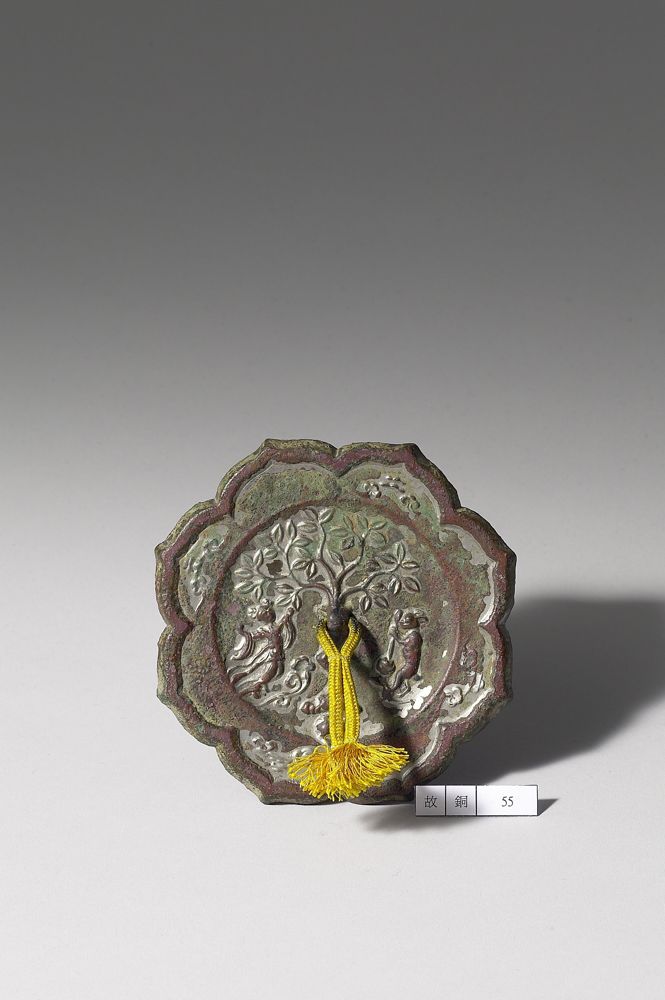
National Palace Museum, Taipei · CC BY 4.0 · K1A000055N000000000PAA · View at the museum
Licence: CC BY 4.0Foliated bronze mirror decorated with Moon Palace
The back of this bronze mirror shows the palace of the moon. Who lives there?
A hare, standing on its hind legs with a pestle: the jade hare, who pounds the elixir of life. On the other side floats Chang'e, the goddess of the moon.
Where Europeans saw a face in the moon, people in China saw a hare under a great tree. The polished front of the mirror showed its owner's face; the back carried the moon. It is now in the National Palace Museum in Taipei.
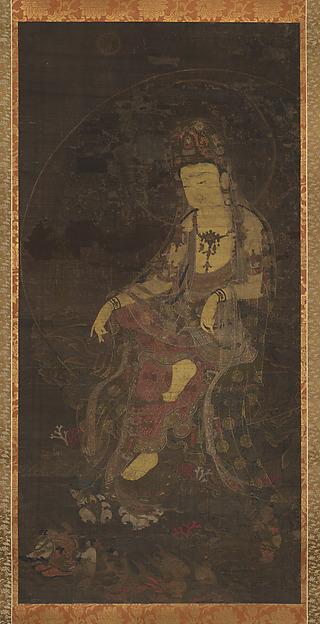
Charles Stewart Smith Collection, Gift of Mrs. Charles Stewart Smith, Charles Stewart Smith Jr., and Howard Caswell Smith, in memory of Charles Stewart Smith, 1 · 14.76.6 · View at the museum
Licence: CC0 (Open Access)Water-moon Avalokiteshvara
The bodhisattva of compassion sits at ease by the water. Where is the moon?
Up near the top, on the left: a tiny moon, and in it a hare pounding the elixir of immortality.
Painters in Goryeo Korea gave this subject gold and fine colours on silk, and very few of their paintings survive.

Rosenwald Collection · 1943.3.3497 · View at the museum
Licence: CC0 (Open Access)The Virgin and Child on a Crescent with a Starry Crown
Mary stands on something. What is it?
A crescent moon. In the Book of Revelation, a woman appears with the moon under her feet and a crown of stars, and artists gave both to Mary.
Dürer engraved this in copper in 1508. Look at the bottom of the print: the year, and his monogram, AD.

J. Paul Getty Museum · CC0 · descriptions CC BY 4.0 · 2000.27 · View at the museum
Licence: CC0 (descriptions CC BY 4.0)Moonlit Landscape with a View of the New Amstel River and Castle Kostverloren
The moon lights up the river. Which building stands out against the sky?
Castle Kostverloren, on the New Amstel River near Amsterdam. Van der Neer usually painted imaginary places, so a real landmark is rare in his work.
Most Dutch landscape painters of the 1600s chose blue skies full of clouds. Van der Neer mastered the night. He painted this scene in the studio, so the river is not quite as it was: Dutch artists then usually composed idealised scenes indoors.
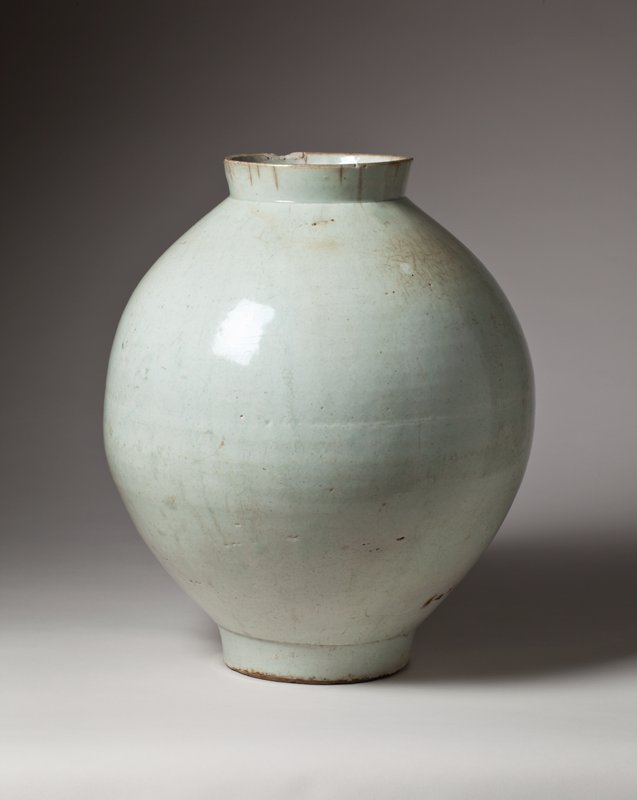
Minneapolis Institute of Art · Public Domain · 2015.79.498 · View at the museum
Licence: Public DomainMoon jar
There is no moon painted on this jar. So why is it called a moon jar?
Moon jars are named for their milky white and their round shape, like a full moon. Around the middle you can see a seam: it was made from two bowls joined together.
Moon jars were thrown in two halves on the potter's wheel and joined, so their shapes vary: some are round, others, like this one, more oval. They were used to store dry goods in daily life, and as vessels for ceremonies.

Bequest of Edward L. Whittemore · 1930.187 · View at the museum
Licence: CC0 (Open Access)Full Moon over Takanawa, from the series Famous Places in the Eastern Capital
What flies across the full moon?
Wild geese, in a long line, over the bay of Takanawa in Edo, today's Tokyo.
Hiroshige designed this colour woodblock print for a series of famous places in Edo. Geese and a full moon were a favourite pairing in Japanese poetry and painting, a sign of autumn.

J. Paul Getty Museum · CC0 · descriptions CC BY 4.0 · 84.XC.729.480 · View at the museum
Licence: CC0 (descriptions CC BY 4.0)The Moon (left) Aug. 12, 1862; (right) Oct. 3, 1860
Two photographs of the moon, side by side. Are they the same?
Almost, but not quite. They were taken nearly two years apart, and the moon shows itself very slightly turned. Seen through a stereoscope, the pair merges into one moon that looks round, like a ball.
Warren De la Rue, a British astronomer, was one of the first to photograph the moon through a telescope. This card was made to be looked at through a stereoscope.
Gift of George A. Hearn, in memory of Arthur Hoppock Hearn, 1911 · 11.116.2 · View at the museum
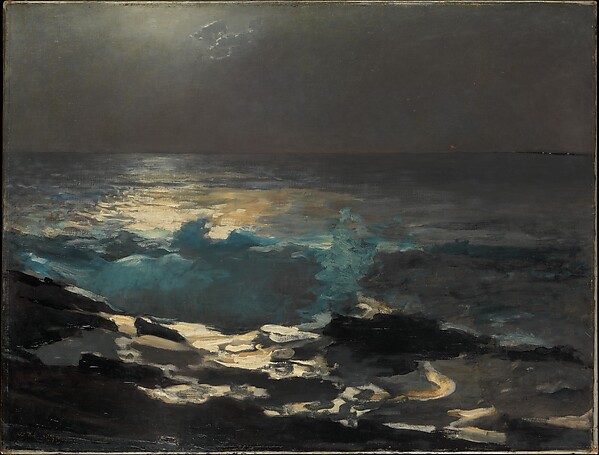
Licence: CC0 (Open Access)Moonlight, Wood Island Light
The moon itself is hidden. Where do you see its light?
On the water: a path of light across the waves, and white foam breaking on the dark rocks.
Winslow Homer lived at Prouts Neck, on the coast of Maine, and painted the sea in every weather, by day and by night.

Los Angeles County Museum of Art · Public Domain · 48.32.46 · View at the museum
Licence: Public DomainMoonlight: Walls of Tangiers
Moonlight turns the old walls blue and green. Who walks at their foot?
A few cloaked figures, small and dark, in the shadow of the walls.
Henry Ossawa Tanner, an African American painter, made his home in France and travelled to Morocco. After that trip, he painted many scenes of Tangier, this one at night, in cool moonlit blues.
The end of the tour
Ten moons.
A god, a hare, a bodhisattva, a crescent, a castle, a jar, geese, photographs, the sea and a city by night: one moon, seen in many ways, across more than fifteen hundred years.
Questions at the end
Who lives in the palace of the moon on the Chinese mirror?
- The goddess Chang'e and a hare (correct)
- A man and his dog
- An owl and a cat
Chang'e floats beside the great tree, and the jade hare pounds the elixir of life.
Why is the Korean moon jar called a moon jar?
- For its milky white colour and round shape (correct)
- Because a moon is painted on it
- Because it was made by moonlight
It is named for its milk-white colour and its round form, like a full moon.
What does Mary stand on in Dürer's engraving?
- A crescent moon (correct)
- A cloud
- A globe
She stands on a crescent, like the woman 'with the moon under her feet' in the Book of Revelation.
Works from these collections
- Museo Egizio
- National Palace Museum
- The Metropolitan Museum of Art
- National Gallery of Art
- J. Paul Getty Museum
- Minneapolis Institute of Art
- Cleveland Museum of Art
- Los Angeles County Museum of Art
More tours
- Artists of Switzerland in the world's museumsTen artists born or at home in Switzerland, from Liotard to Klee, in nine museums around the world.
- Animal huntEight animals are hiding in works of art from all over the world. Can you find them?
- 1,800 years of facesTen portraits, from Roman Egypt to Van Gogh. Look for the clues: who, when, and why?
- The world around 1600What were artists making around 1600? A journey westward from Japan to Spain, in ten works, most of them made within about ten years of that date.
- Blue and whiteHow cobalt blue on white travelled from China to Turkey, Holland, Japan, Mexico, Korea and England: ten pieces, roughly in the order they were made.
- The seaWaves, a storm, a calm, a harbour and a sunrise: eight ways of looking at the sea, across 3,000 years.
- A walk through the seasonsA calm walk from spring to winter, in eight works. Large text, a gentle voice and no hurry.
- Look closerSeven famous works, each with a small detail most people miss. Find it yourself, then hear its story.
- How old is it?Eight works from four museums. Guess when each was made before you hear the story: some are far older than they look, and two are younger.
- Albrecht DürerEleven works by the painter and printmaker from Nuremberg: a self-portrait, a rhinoceros and a magic square.
- Rembrandt, in the mirrorTen self-portraits, painted, etched and drawn: from the curly-haired young man to the old master.
- VermeerThirteen of his rare paintings, in the order he made them: quiet rooms, letters and light.
- Giovanni Battista PiranesiRome, real and imagined, in the order he etched it: ruins, squares, prisons, temples and a fireplace.
- J. M. W. TurnerStorms, fire, moonlight and golden haze, in order of date: from a Welsh castle to a storm at sea.
- Hokusai & HiroshigeThe two masters of the Japanese landscape print, side by side: ten prints, in roughly the order they were made.
- Claude MonetEleven paintings in the order he made them: the sea, Camille, grainstacks, a cathedral, London fog and his pond.
- Mary CassattFrom Seville to Paris: a theatre box, a letter, an omnibus and a boat trip. Ten paintings, prints and a pastel, in the order she made them.
- Helene SchjerfbeckFrom a soldier in the snow to a face of a few strokes: ten works, in the order she made them.
- Van GoghTen years of work, from the grey Dutch coast to the colours of the south: eleven works, in the order he made them.
- Vilhelm HammershøiGrey rooms, white doors, light on the floor and a woman seen from behind: ten works, roughly in the order he made them.
Back to the start page · all tours · press