Guided tour · Detective · Detective
Look closer
Seven famous works, each with a small detail most people miss. Find it yourself, then hear its story.
Start this tour in AuriaanOpens the interactive flight at this tour, with a guide's voice. It needs a modern browser; the same works are shown below.
- Works
- 7
- Time
- about 9 min
- Collections
- 2
About this tour
Seven works, each with a hidden detail. At every work, read the clue and tap the picture where you find it. If you get stuck, a hint follows after two tries.
Our first case is a wave from Japan.
The 7 works

Rogers Fund, 1914 · JP10 · View at the museum
Licence: CC0 (Open Access)Under the Wave off Kanagawa (The Great Wave)
A giant wave is about to fall on three boats. But a mountain is hiding in this picture too. Can you find it?
Mount Fuji, small and calm, framed by the wave.
Hokusai made this print around 1830 to 1832 for his series Thirty-six Views of Mount Fuji, so the mountain had to be in every picture. Here the most famous mountain in Japan looks tiny next to the sea.

Purchase, Joseph Pulitzer Bequest, 1918 · JP643 · View at the museum
Licence: CC0 (Open Access)Sudden Shower over Shin-Ōhashi Bridge and Atake
People hurry across a bridge in a sudden shower. Someone else is out on the river. Can you find him?
A man poling a long raft through the rain.
Hiroshige made this print in 1857 for his series One Hundred Famous Views of Edo, today's Tokyo. The rain is cut into the woodblock as fine dark lines. Van Gogh admired it so much that he painted his own copy.
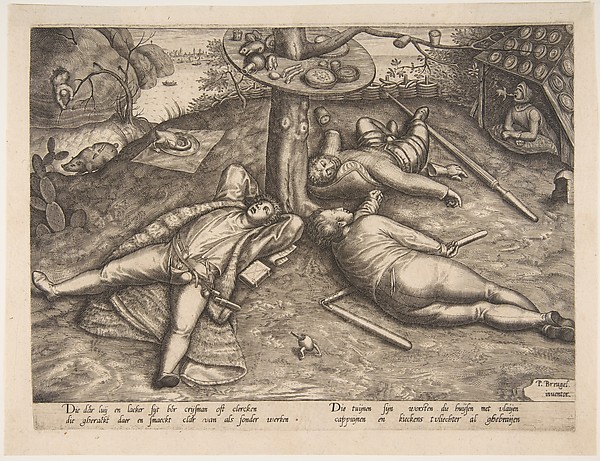
Harris Brisbane Dick Fund, 1926 · 26.72.44 · View at the museum
Licence: CC0 (Open Access)The Land of Cockaigne
In the Land of Cockaigne, food comes to you by itself. Something is walking towards the sleepers on little legs. Can you find it?
An egg, with a knife stuck in it, walking on little legs.
This print follows a painting by Pieter Bruegel the Elder. A soldier and a farmer sleep off their feast and a clerk waits for more to drink, while a roast pig runs past with a knife in its back. It pokes fun at gluttony and laziness.

Rijksmuseum, Amsterdam · Public Domain · SK-A-1718 · View at the museum
Licence: Public DomainWinter Landscape with Ice Skaters
Hundreds of people are out on the ice. One of them has just fallen over. Can you find him?
A skater flat on his back, legs in the air.
Hendrick Avercamp painted this winter scene around 1608, when frozen rivers and canals became meeting places for everyone, rich and poor. Avercamp could not speak; he watched people closely and filled his pictures with little stories.

Rijksmuseum, Amsterdam · Public Domain · SK-C-5 · View at the museum
Licence: Public DomainThe Night Watch
Rembrandt's most famous painting is full of men with weapons. But a girl is walking among them. Can you find her?
A girl in golden yellow, with a chicken hanging from her belt.
Rembrandt painted this company of Amsterdam's civic guard in 1642. The girl may stand for the company itself: the claws of the chicken were its emblem. Instead of a neat row of portraits, Rembrandt painted everyone on the move.

Rijksmuseum, Amsterdam · Public Domain · SK-A-4 · View at the museum
Licence: Public DomainThe Threatened Swan
This swan is defending its nest with all its strength. Against what? Find the intruder.
A dog, swimming towards the nest.
Jan Asselijn painted this around 1650. Later, words were added, and the swan came to stand for Johan de Witt, a Dutch statesman defending his country. In 1800 it was the first painting bought for the national art gallery that became the Rijksmuseum.

Rijksmuseum, Amsterdam · Public Domain · SK-A-2344 · View at the museum
Licence: Public DomainThe Milkmaid
A maid pours milk, very carefully. On the floor stands something that kept feet warm. Can you find it?
A foot warmer: a small wooden box that held a pot of glowing coals.
Johannes Vermeer painted The Milkmaid around 1660. Even the bread, the jug and the nail holes in the wall are painted with great care. Look at the small tiles beside the foot warmer: one shows Cupid, the god of love.
The end of the tour
A mountain, a raft, a walking egg, a fallen skater, a girl with a chicken, a dog and a foot warmer: small details often tell the biggest stories.
Works from these collections
More tours
- Artists of Switzerland in the world's museumsTen artists born or at home in Switzerland, from Liotard to Klee, in nine museums around the world.
- Animal huntEight animals are hiding in works of art from all over the world. Can you find them?
- 1,800 years of facesTen portraits, from Roman Egypt to Van Gogh. Look for the clues: who, when, and why?
- The world around 1600What were artists making around 1600? A journey westward from Japan to Spain, in ten works, most of them made within about ten years of that date.
- Blue and whiteHow cobalt blue on white travelled from China to Turkey, Holland, Japan, Mexico, Korea and England: ten pieces, roughly in the order they were made.
- The moonA god, a hare, a bodhisattva, a crescent, a castle, a jar, geese, photographs, the sea and a city by night: the moon in ten works from around the world.
- The seaWaves, a storm, a calm, a harbour and a sunrise: eight ways of looking at the sea, across 3,000 years.
- A walk through the seasonsA calm walk from spring to winter, in eight works. Large text, a gentle voice and no hurry.
- How old is it?Eight works from four museums. Guess when each was made before you hear the story: some are far older than they look, and two are younger.
- Albrecht DürerEleven works by the painter and printmaker from Nuremberg: a self-portrait, a rhinoceros and a magic square.
- Rembrandt, in the mirrorTen self-portraits, painted, etched and drawn: from the curly-haired young man to the old master.
- VermeerThirteen of his rare paintings, in the order he made them: quiet rooms, letters and light.
- Giovanni Battista PiranesiRome, real and imagined, in the order he etched it: ruins, squares, prisons, temples and a fireplace.
- J. M. W. TurnerStorms, fire, moonlight and golden haze, in order of date: from a Welsh castle to a storm at sea.
- Hokusai & HiroshigeThe two masters of the Japanese landscape print, side by side: ten prints, in roughly the order they were made.
- Claude MonetEleven paintings in the order he made them: the sea, Camille, grainstacks, a cathedral, London fog and his pond.
- Mary CassattFrom Seville to Paris: a theatre box, a letter, an omnibus and a boat trip. Ten paintings, prints and a pastel, in the order she made them.
- Helene SchjerfbeckFrom a soldier in the snow to a face of a few strokes: ten works, in the order she made them.
- Van GoghTen years of work, from the grey Dutch coast to the colours of the south: eleven works, in the order he made them.
- Vilhelm HammershøiGrey rooms, white doors, light on the floor and a woman seen from behind: ten works, roughly in the order he made them.
Back to the start page · all tours · press