Guided tour · One artist · Leiden · Amsterdam · 1606–1669
Rembrandt, in the mirror
Ten self-portraits, painted, etched and drawn: from the curly-haired young man to the old master.
Start this tour in AuriaanOpens the interactive flight at this tour, with a guide's voice. It needs a modern browser; the same works are shown below.
- Works
- 10
- Time
- about 15 min
- Collections
- 5
About this tour
Rembrandt portrayed himself about 80 times, more than almost any artist before him: in paint, in etchings and in drawings. Here are ten, from Leiden to Amsterdam, in the order he made them. At every work, look first, then discover.
We begin in Leiden, around 1628. Rembrandt is about 22.
The 10 works

Rijksmuseum, Amsterdam · Public Domain · SK-A-4691 · View at the museum
Licence: Public DomainSelf-portrait
Can you see his eyes?
Only just: they are in deep shadow, while the light flashes along his cheek. Yet he is looking straight at us.
The young Rembrandt was experimenting. He scratched into the wet paint with the back of his brush to bring out the curls of his hair.

J. Paul Getty Museum · CC0 · descriptions CC BY 4.0 · 2013.60 · View at the museum
Licence: CC0 (descriptions CC BY 4.0)Rembrandt Laughing
He has dressed up. What is he wearing around his neck?
A steel gorget, a piece of armour: he is playing a soldier, and laughing at us.
It is small and painted on copper. He signed it with the monogram RHL, Rembrandt Harmenszoon of Leiden, which he used only briefly.

Rosenwald Collection · 1943.3.7264 · View at the museum
Licence: CC0 (Open Access)Self-Portrait in a Cap, Open-Mouthed
What is he feeling?
Surprise, or shock: eyes wide open, eyebrows raised, lips pursed.
Painters were advised to study emotions in a mirror, and the young Rembrandt did just that. These faces return in his later work.

Yale University Art Gallery · Public Domain · 1925.93 · View at the museum
Licence: Public DomainSelf-Portrait with Raised Sabre
What is he holding?
A curved sabre. With the fur cap and the heavy chain, he plays a warrior from a distant land.
Rembrandt often dressed up for his self-portraits: as a beggar, a soldier, a nobleman.

Gift of Henry Walters, 1917 · 17.37.71 · View at the museum
Licence: CC0 (Open Access)Self-Portrait with Saskia
Who is sitting beside him?
Saskia van Uylenburgh, his wife. They had married two years earlier.
He sits at the table with a drawing tool in his hand: an artist at work, with his wife at his side.
Robert Lehman Collection, 1975 · 1975.1.800 · View at the museum
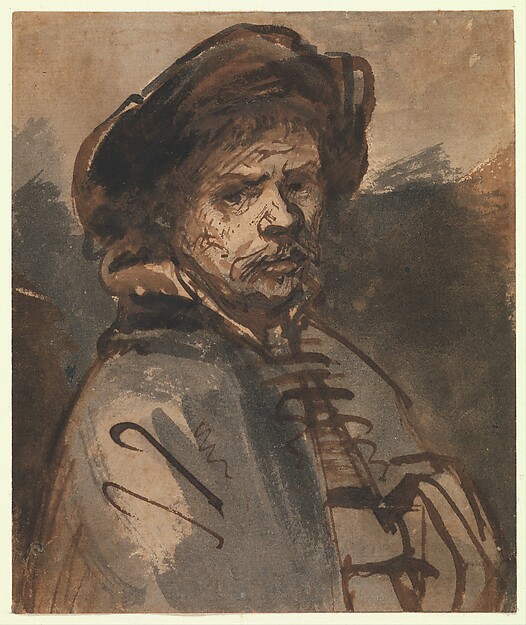
Licence: CC0 (Open Access)Self-Portrait
Painted or drawn? Look at the lines.
Drawn, with a pen and brown ink, and washes of brown and grey laid on with a brush.
Fast strokes for the beret and the coat, more care for the face and the eyes.

Gift of R. Horace Gallatin · 1949.1.52 · View at the museum
Licence: CC0 (Open Access)Self-Portrait Leaning on a Stone Sill
Look at how he sits. What is he leaning on?
A stone sill. The pose was inspired by famous Renaissance portraits by Raphael and Titian, both then in Amsterdam.
In a velvet beret and a fine coat, Rembrandt presents himself as their equal.

Rijksmuseum, Amsterdam · Public Domain · RP-P-1962-9 · View at the museum
Licence: Public DomainSelf-portrait, Etching at a Window
What is he doing?
Working, at a window, his paper on a thick book. The plain hat was part of his studio work clothes.
By combining etching and drypoint, he made the light and the dark as soft as in a painting.

Andrew W. Mellon Collection · 1937.1.72 · View at the museum
Licence: CC0 (Open Access)Self-Portrait
Look at his face up close. How did he paint it?
With visible strokes of thick paint. In the hair he scratched lines into the wet paint, just as he did thirty years earlier.
The year before, after he had gone bankrupt, his house and his possessions were sold at auction. He paints himself as he is.

Rijksmuseum, Amsterdam · Public Domain · SK-A-4050 · View at the museum
Licence: Public DomainSelf-portrait as the Apostle Paul
He has dressed up again, as a saint. Which clues tell us who?
The handle of a sword sticking out of his cloak, and a manuscript in his hands: the signs of the apostle Paul.
Rembrandt is 55 here, and he still looks at himself candidly.
The end of the tour
Forty years in the mirror.
From the young man in Leiden, pulling faces and dressing up, to the old painter who looked at himself without flattery. Rembrandt died in Amsterdam in 1669.
Questions at the end
How did the young Rembrandt bring out the curls in his wet paint?
- He scratched them with the back of his brush (correct)
- He used a comb
- He pressed his fingers into the paint
In the early self-portrait in the Rijksmuseum he scratched into the wet paint with the butt end of his brush.
Why did he pull faces in front of a mirror?
- To study emotions for his paintings (correct)
- To amuse his wife
- Because he could not pay models
Artists were advised to practise expressions in a mirror, and these emotions return in his later work.
In 1639 his pose was inspired by…
- Renaissance portraits by Raphael and Titian (correct)
- a statue of a king
- a portrait of his father
Famous portraits by Raphael and Titian were then in Amsterdam, and inspired his pose.
Works from these collections
- Rijksmuseum
- J. Paul Getty Museum
- National Gallery of Art
- Yale University Art Gallery
- The Metropolitan Museum of Art
More tours
- Artists of Switzerland in the world's museumsTen artists born or at home in Switzerland, from Liotard to Klee, in nine museums around the world.
- Animal huntEight animals are hiding in works of art from all over the world. Can you find them?
- 1,800 years of facesTen portraits, from Roman Egypt to Van Gogh. Look for the clues: who, when, and why?
- The world around 1600What were artists making around 1600? A journey westward from Japan to Spain, in ten works, most of them made within about ten years of that date.
- Blue and whiteHow cobalt blue on white travelled from China to Turkey, Holland, Japan, Mexico, Korea and England: ten pieces, roughly in the order they were made.
- The moonA god, a hare, a bodhisattva, a crescent, a castle, a jar, geese, photographs, the sea and a city by night: the moon in ten works from around the world.
- The seaWaves, a storm, a calm, a harbour and a sunrise: eight ways of looking at the sea, across 3,000 years.
- A walk through the seasonsA calm walk from spring to winter, in eight works. Large text, a gentle voice and no hurry.
- Look closerSeven famous works, each with a small detail most people miss. Find it yourself, then hear its story.
- How old is it?Eight works from four museums. Guess when each was made before you hear the story: some are far older than they look, and two are younger.
- Albrecht DürerEleven works by the painter and printmaker from Nuremberg: a self-portrait, a rhinoceros and a magic square.
- VermeerThirteen of his rare paintings, in the order he made them: quiet rooms, letters and light.
- Giovanni Battista PiranesiRome, real and imagined, in the order he etched it: ruins, squares, prisons, temples and a fireplace.
- J. M. W. TurnerStorms, fire, moonlight and golden haze, in order of date: from a Welsh castle to a storm at sea.
- Hokusai & HiroshigeThe two masters of the Japanese landscape print, side by side: ten prints, in roughly the order they were made.
- Claude MonetEleven paintings in the order he made them: the sea, Camille, grainstacks, a cathedral, London fog and his pond.
- Mary CassattFrom Seville to Paris: a theatre box, a letter, an omnibus and a boat trip. Ten paintings, prints and a pastel, in the order she made them.
- Helene SchjerfbeckFrom a soldier in the snow to a face of a few strokes: ten works, in the order she made them.
- Van GoghTen years of work, from the grey Dutch coast to the colours of the south: eleven works, in the order he made them.
- Vilhelm HammershøiGrey rooms, white doors, light on the floor and a woman seen from behind: ten works, roughly in the order he made them.
Back to the start page · all tours · press