Guided tour · One artist · 1760–1849 · 1797–1858
Hokusai & Hiroshige
The two masters of the Japanese landscape print, side by side: ten prints, in roughly the order they were made.
Start this tour in AuriaanOpens the interactive flight at this tour, with a guide's voice. It needs a modern browser; the same works are shown below.
- Works
- 10
- Time
- about 15 min
- Collections
- 5
About this tour
Katsushika Hokusai and Utagawa Hiroshige both lived in Edo, today's Tokyo. From the 1830s they made the landscape print famous, and their views travelled the world. Here are ten of their prints from five museums, in roughly the order they were made. At every work, look first, then discover.
We begin around 1830. Hokusai is already seventy.
The 10 works

Henry L. Phillips Collection, Bequest of Henry L. Phillips, 1939 · JP2944 · View at the museum
Licence: CC0 (Open Access)The Suspension Bridge on the Border of Hida and Etchū Provinces
How high is this bridge? Look for a clue.
Birds fly beneath it. Two travellers, one with a heavy load, cross the rope bridge high above the valley.
It comes from Hokusai's series of remarkable bridges in the provinces of Japan.
Rogers Fund, 1914 · JP9 · View at the museum
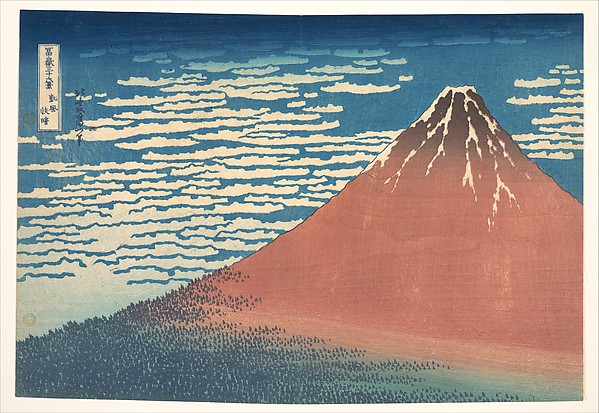
Licence: CC0 (Open Access)South Wind, Clear Sky (Red Fuji)
Why is the mountain red?
Between late summer and early autumn, Fuji can take on a reddish hue. Only streaks of snow are left near the top.
With very few colours, Hokusai made one of the best-known images of Japan.

The Howard Mansfield Collection, Purchase, Rogers Fund, 1936 · JP2553 · View at the museum
Licence: CC0 (Open Access)Ejiri in Suruga Province
What is the wind carrying away?
Sheets of paper and a hat, whirling up into the sky.
The travellers bend into the gust. Mount Fuji is no more than a thin outline on the left.

Museum Accession · JP1081 · View at the museum
Licence: CC0 (Open Access)Kirifuri Waterfall at Kurokami Mountain
Find the people at this waterfall.
Small travellers at the foot of the falls, looking up. Two more climb among the trees at the top right.
The water splits into streams like fingers. Kirifuri Falls are near Nikkō, north of Edo.
The Kelvin Smith Collection, given by Mrs. Kelvin Smith · 1985.317 · View at the museum
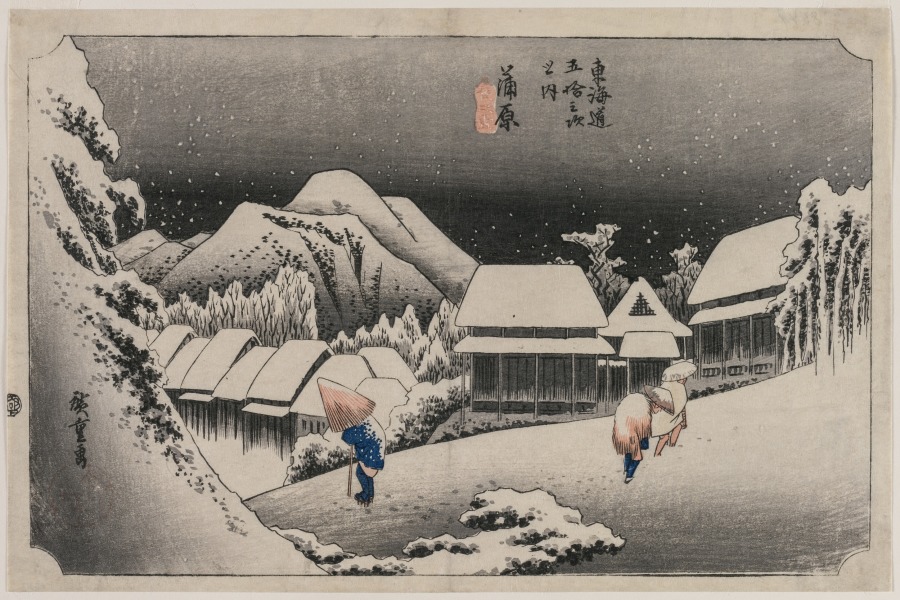
Licence: CC0 (Open Access)Evening Snow at Kambara
How did Hiroshige make the falling snow?
By leaving the paper white: the flakes were carved out of the woodblock, so the paper shows through.
Snow rarely falls in the coastal town of Kambara. This may be the first print by Hiroshige to show falling snow.

Princeton University Art Museum · Public Domain · x1940-8.2.5 · View at the museum
Licence: Public DomainOne Hundred Views of Mount Fuji
Something is rising past the mountain. What is it?
A dragon, its claws reaching out of the swirling clouds.
In this book Hokusai wrote that at a hundred he hoped to reach the divine in his art. He signed it as the old man mad about painting.

The Harry G. C. Packard Collection of Asian Art, Gift of Harry G. C. Packard, and Purchase, Fletcher, Rogers, Harris Brisbane Dick, and Louis V. Bell Funds, Jos · JP3510 · View at the museum
Licence: CC0 (Open Access)The Monkey Bridge in Kai Province
This picture is very tall. What spans the gorge, high up?
A wooden bridge, with a traveller crossing it. Below it, between the trees, hangs a full moon.
It is made of two prints, one above the other, mounted as a hanging scroll. Far below, the river rushes through the gorge.
National Museum in Kraków · Public Domain · MNK VI-1151 · View at the museum
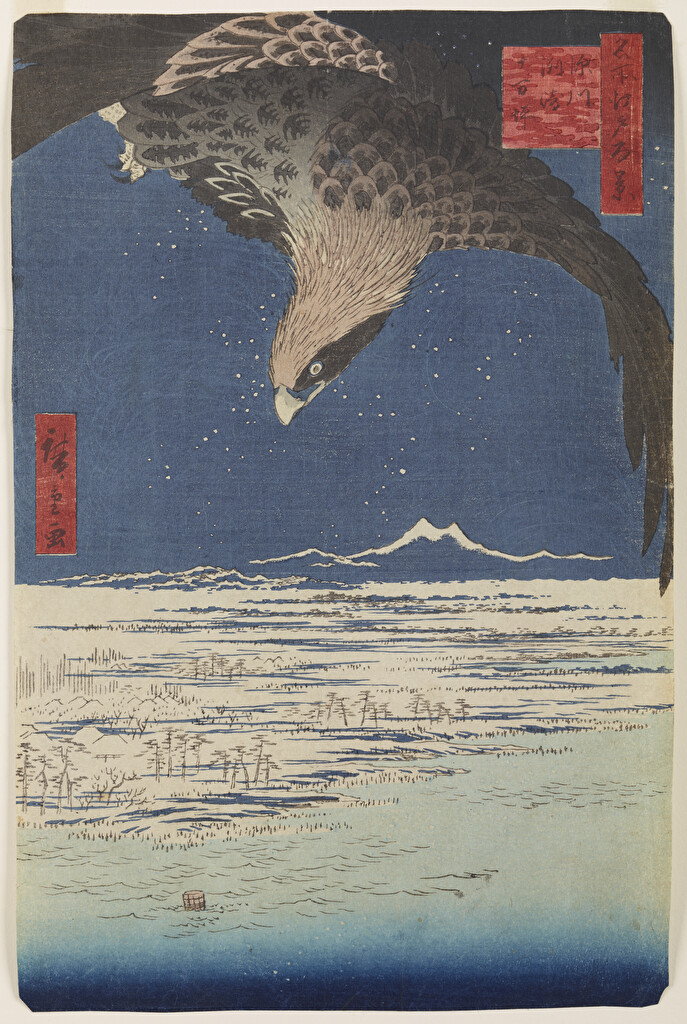
Licence: Public DomainEagle over Jūmantsubo Plain
Who is watching over this snowy plain?
An eagle, soaring with its sharp eye on the ground below.
From One Hundred Famous Views of Edo. The bird fills the sky; the plain lies far below, under snow.

Rijksmuseum, Amsterdam · Public Domain · RP-P-1956-743 · View at the museum
Licence: Public DomainThe Plum Garden at Kameido Shrine
What fills the front of this picture?
An old plum tree, cut off by the edges of the print. Behind it, visitors picnic among the blossom.
In 1887, in Paris, Van Gogh copied this print in oil. His copy is in the Van Gogh Museum in Amsterdam.

Rijksmuseum, Amsterdam · Public Domain · RP-P-1956-752 · View at the museum
Licence: Public DomainSudden Shower over Ohashi Bridge at Atake
How did Hiroshige draw the rain?
As fine dark lines. On the bridge, people hurry under umbrellas, a big hat and a reed mat.
On the river, a man poles a raft of logs. Van Gogh copied this print too, and framed his copy with Japanese characters.
The end of the tour
Two masters, one floating world.
Hokusai worked until he was almost ninety, Hiroshige until his death in 1858. Their prints reached Europe and inspired painters such as Van Gogh and Monet.
Questions at the end
How did Hiroshige make the falling snow at Kambara?
- By leaving the paper white (correct)
- With white paint added by hand
- With salt on the wet print
The flakes were carved out of the woodblock, so the paper shows through.
Which painter copied Hiroshige's plum garden and his bridge in the rain?
- Van Gogh (correct)
- Rembrandt
- Turner
Van Gogh copied both prints in oil, in Paris in 1887.
What did Hokusai call himself in his seventies?
- The old man mad about painting (correct)
- The master of the wave
- The traveller of Edo
He signed his One Hundred Views of Mount Fuji as the old man mad about painting.
Works from these collections
- The Metropolitan Museum of Art
- Cleveland Museum of Art
- Princeton University Art Museum
- National Museum in Kraków
- Rijksmuseum
More tours
- Artists of Switzerland in the world's museumsTen artists born or at home in Switzerland, from Liotard to Klee, in nine museums around the world.
- Animal huntEight animals are hiding in works of art from all over the world. Can you find them?
- 1,800 years of facesTen portraits, from Roman Egypt to Van Gogh. Look for the clues: who, when, and why?
- The world around 1600What were artists making around 1600? A journey westward from Japan to Spain, in ten works, most of them made within about ten years of that date.
- Blue and whiteHow cobalt blue on white travelled from China to Turkey, Holland, Japan, Mexico, Korea and England: ten pieces, roughly in the order they were made.
- The moonA god, a hare, a bodhisattva, a crescent, a castle, a jar, geese, photographs, the sea and a city by night: the moon in ten works from around the world.
- The seaWaves, a storm, a calm, a harbour and a sunrise: eight ways of looking at the sea, across 3,000 years.
- A walk through the seasonsA calm walk from spring to winter, in eight works. Large text, a gentle voice and no hurry.
- Look closerSeven famous works, each with a small detail most people miss. Find it yourself, then hear its story.
- How old is it?Eight works from four museums. Guess when each was made before you hear the story: some are far older than they look, and two are younger.
- Albrecht DürerEleven works by the painter and printmaker from Nuremberg: a self-portrait, a rhinoceros and a magic square.
- Rembrandt, in the mirrorTen self-portraits, painted, etched and drawn: from the curly-haired young man to the old master.
- VermeerThirteen of his rare paintings, in the order he made them: quiet rooms, letters and light.
- Giovanni Battista PiranesiRome, real and imagined, in the order he etched it: ruins, squares, prisons, temples and a fireplace.
- J. M. W. TurnerStorms, fire, moonlight and golden haze, in order of date: from a Welsh castle to a storm at sea.
- Claude MonetEleven paintings in the order he made them: the sea, Camille, grainstacks, a cathedral, London fog and his pond.
- Mary CassattFrom Seville to Paris: a theatre box, a letter, an omnibus and a boat trip. Ten paintings, prints and a pastel, in the order she made them.
- Helene SchjerfbeckFrom a soldier in the snow to a face of a few strokes: ten works, in the order she made them.
- Van GoghTen years of work, from the grey Dutch coast to the colours of the south: eleven works, in the order he made them.
- Vilhelm HammershøiGrey rooms, white doors, light on the floor and a woman seen from behind: ten works, roughly in the order he made them.
Back to the start page · all tours · press