Guided tour · For students
1,800 years of faces
Ten portraits, from Roman Egypt to Van Gogh. Look for the clues: who, when, and why?
Start this tour in AuriaanOpens the interactive flight at this tour, with a guide's voice. It needs a modern browser; the same works are shown below.
- Works
- 10
- Time
- about 14 min
- Collections
- 6
About this tour
Ten faces, painted, printed and photographed over almost 1,800 years. At every work, look first: what can you find out before you read anything? Then compare. What changes over time, and what stays the same?
We begin in Egypt, around the year 100, when Egypt was part of the Roman Empire.
The 10 works

J. Paul Getty Museum · CC0 · descriptions CC BY 4.0 · 81.AP.42 · View at the museum
Licence: CC0 (descriptions CC BY 4.0)Mummy Portrait of a Woman
What can you tell about this woman just by looking? Find three clues.
Gold leaves in her hair, gold earrings and a necklace: she was a wealthy woman.
This portrait lay over the face of her mummy. Her name, Isidora, is written in Greek on the wrappings. Painted in coloured wax, it still glows after almost 2,000 years.
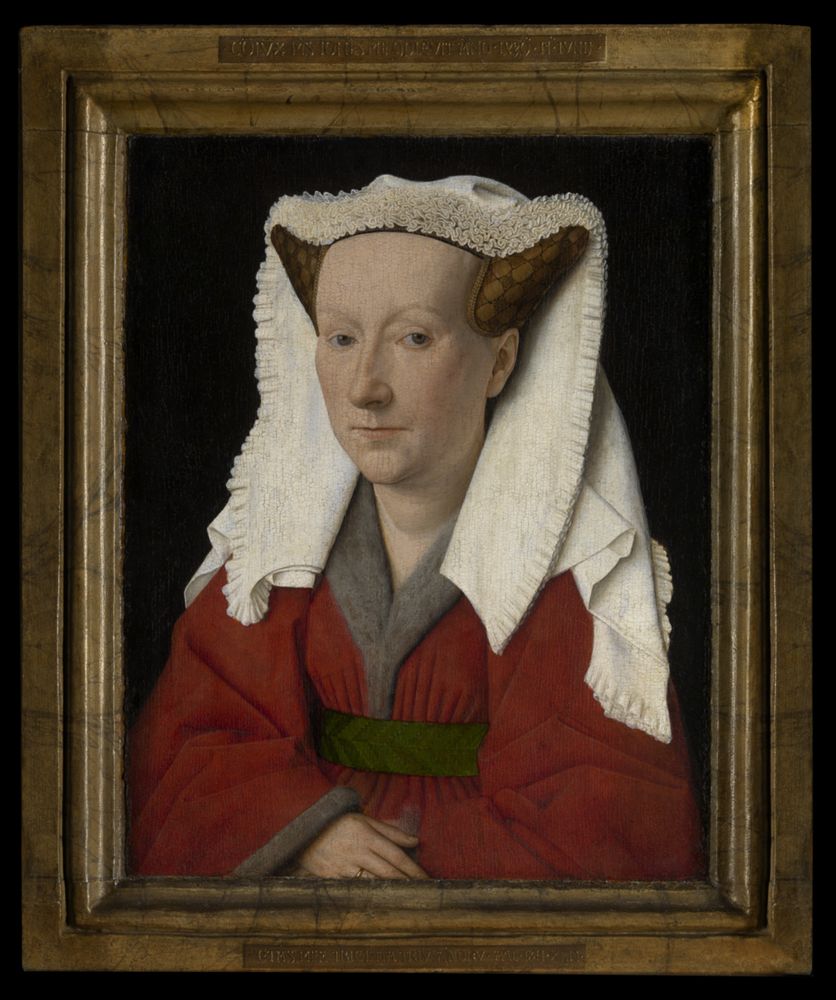
Musea Brugge · Public Domain · 0000.GRO0162.I · View at the museum
Licence: Public DomainPortrait of Margareta van Eyck
This portrait talks to you. Can you find where?
On the frame it says, in Latin: “My husband Johannes completed me in 1439. My age was thirty-three.” It ends with Jan van Eyck's motto: “As I can.”
It is one of the earliest known portraits of a painter's wife. Margareta looks straight at us.

Ailsa Mellon Bruce Fund · 1967.6.1.a · View at the museum
Licence: CC0 (Open Access)Ginevra de' Benci
What is growing behind her? Why might the painter have chosen it?
A juniper bush. In Italian, juniper is “ginepro”, which sounds like her name: Ginevra.
Leonardo da Vinci painted Ginevra de' Benci when he was in his twenties. It is the only painting by Leonardo in the Americas.

Seymour Fund, 1959 · 59.49.1 · View at the museum
Licence: CC0 (Open Access)Portrait of the artist's great-granduncle Yizhai at the age of eighty-five
What in his face shows that he is old?
The white beard, the thin face and the tired eyes: he is 85.
In China, portraits like this celebrated elders while they lived, and could later be used to honour them as ancestors.

Gift of Mr. and Mrs. Robert Woods Bliss · 1949.6.1 · View at the museum
Licence: CC0 (Open Access)Self-Portrait
What is she doing? What does she want you to know about her?
She is at work, with about twenty brushes and her palette in her hand. On the easel: a cheerful violinist, the kind of picture she was known for.
She was about twenty. A few years later she was one of the first women in Haarlem's painters' guild, with her own workshop and pupils.

Rijksmuseum, Amsterdam · Public Domain · SK-A-4050 · View at the museum
Licence: Public DomainSelf-portrait as the Apostle Paul
Rembrandt has dressed up as someone else. Can you find two clues?
The letters in his hands, and the handle of a sword sticking out of his cloak: he plays the Apostle Paul, who wrote letters in the Bible.
Rembrandt was 55. He painted himself many times in his life and never hid his age: look at the wrinkles and the thick paint.
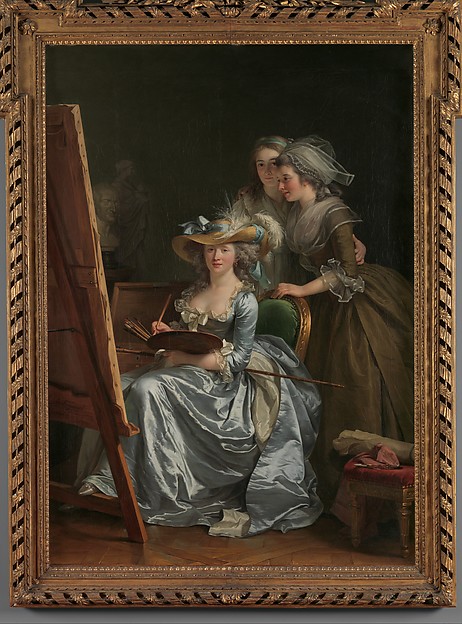
Gift of Julia A. Berwind, 1953 · 53.225.5 · View at the museum
Licence: CC0 (Open Access)Self-Portrait with Two Pupils
Who are the two women behind her? What might the painter want to tell us with them?
They are her pupils, Marie Gabrielle Capet and Marie Marguerite Carreaux de Rosemond.
At that time the French Royal Academy let in only four women. Adélaïde Labille-Guiard was one of them, and here she shows herself as a successful painter and a teacher of women artists.

Rijksmuseum, Amsterdam · Public Domain · RP-P-1963-16 · View at the museum
Licence: Public DomainBust portrait of Otani Oniji
Is this a portrait of a real person, or of a role? Look at the face and the hands.
Both: the actor Ōtani Oniji, playing the servant of one of the villains in a play staged in 1794. His fierce eyes and tense hands show the role.
Sharaku made all his actor prints in about ten months, then disappeared. Nobody knows for sure who he was. The dark background glitters with mica.

Princeton University Art Museum · Public Domain · 2010-177 · View at the museum
Licence: Public DomainJohn Herschel
This is a photograph. How is it different from the painted portraits before it?
Look at the light: the face comes out of the dark, a little soft, with wild white hair catching the light.
Julia Margaret Cameron photographed her friend Sir John Herschel, a famous astronomer. Herschel was also a pioneer of photography, and gave us the words “negative” and “positive”.

Collection of Mr. and Mrs. John Hay Whitney · 1998.74.5 · View at the museum
Licence: CC0 (Open Access)Self-Portrait
Look at the background. What is it doing?
It moves! The brushstrokes curl around his head like waves, in the same blues as his painter's smock.
Vincent van Gogh painted this in the south of France in 1889, with his palette in his hand. He often painted himself, partly because he could not pay models.
The end of the tour
Ten faces, almost 1,800 years.
From a mummy portrait to Van Gogh: faces made to be remembered, to show wealth or skill, to play a role, and to look honestly at oneself.
Questions at the end
The oldest portrait on this tour was made to…
- hang in a palace
- cover the face of a mummy (correct)
- be sold at a market
Isidora's portrait was laid over her face when she was wrapped as a mummy, in Roman Egypt.
Which clue gave away Ginevra's name?
- Her necklace
- The juniper bush behind her (correct)
- A letter in her hand
Juniper is “ginepro” in Italian: a play on the name Ginevra.
What did Judith Leyster, Rembrandt, Labille-Guiard and Van Gogh all do on this tour?
- They painted a king
- They painted themselves (correct)
- They took photographs
They are all self-portraits: the artists chose how we would see them.
Works from these collections
- J. Paul Getty Museum
- Musea Brugge
- National Gallery of Art
- The Metropolitan Museum of Art
- Rijksmuseum
- Princeton University Art Museum
More tours
- Artists of Switzerland in the world's museumsTen artists born or at home in Switzerland, from Liotard to Klee, in nine museums around the world.
- Animal huntEight animals are hiding in works of art from all over the world. Can you find them?
- The world around 1600What were artists making around 1600? A journey westward from Japan to Spain, in ten works, most of them made within about ten years of that date.
- Blue and whiteHow cobalt blue on white travelled from China to Turkey, Holland, Japan, Mexico, Korea and England: ten pieces, roughly in the order they were made.
- The moonA god, a hare, a bodhisattva, a crescent, a castle, a jar, geese, photographs, the sea and a city by night: the moon in ten works from around the world.
- The seaWaves, a storm, a calm, a harbour and a sunrise: eight ways of looking at the sea, across 3,000 years.
- A walk through the seasonsA calm walk from spring to winter, in eight works. Large text, a gentle voice and no hurry.
- Look closerSeven famous works, each with a small detail most people miss. Find it yourself, then hear its story.
- How old is it?Eight works from four museums. Guess when each was made before you hear the story: some are far older than they look, and two are younger.
- Albrecht DürerEleven works by the painter and printmaker from Nuremberg: a self-portrait, a rhinoceros and a magic square.
- Rembrandt, in the mirrorTen self-portraits, painted, etched and drawn: from the curly-haired young man to the old master.
- VermeerThirteen of his rare paintings, in the order he made them: quiet rooms, letters and light.
- Giovanni Battista PiranesiRome, real and imagined, in the order he etched it: ruins, squares, prisons, temples and a fireplace.
- J. M. W. TurnerStorms, fire, moonlight and golden haze, in order of date: from a Welsh castle to a storm at sea.
- Hokusai & HiroshigeThe two masters of the Japanese landscape print, side by side: ten prints, in roughly the order they were made.
- Claude MonetEleven paintings in the order he made them: the sea, Camille, grainstacks, a cathedral, London fog and his pond.
- Mary CassattFrom Seville to Paris: a theatre box, a letter, an omnibus and a boat trip. Ten paintings, prints and a pastel, in the order she made them.
- Helene SchjerfbeckFrom a soldier in the snow to a face of a few strokes: ten works, in the order she made them.
- Van GoghTen years of work, from the grey Dutch coast to the colours of the south: eleven works, in the order he made them.
- Vilhelm HammershøiGrey rooms, white doors, light on the floor and a woman seen from behind: ten works, roughly in the order he made them.
Back to the start page · all tours · press