Guided tour · One artist · London · 1775–1851
J. M. W. Turner
Storms, fire, moonlight and golden haze, in order of date: from a Welsh castle to a storm at sea.
Start this tour in AuriaanOpens the interactive flight at this tour, with a guide's voice. It needs a modern browser; the same works are shown below.
- Works
- 11
- Time
- about 17 min
- Collections
- 4
About this tour
Joseph Mallord William Turner, the son of a London barber, painted light and weather like no one before him. Here are eleven of his works from four museums, in order of date. At every work, look first, then discover.
We begin on the coast of north Wales in 1798. Turner is 23.
The 11 works

J. Paul Getty Museum · CC0 · descriptions CC BY 4.0 · 95.GC.10 · View at the museum
Licence: CC0 (descriptions CC BY 4.0)Conway Castle, North Wales
Down on the shore, what are the fishermen doing?
Struggling to pull their boats ashore in the storm. Next to the sea and the castle, they look tiny.
Turner made several sketching trips to Wales in the 1790s. Here the sun breaks through the clouds onto the castle.

Yale Center for British Art, Paul Mellon Collection · Public Domain · B1977.14.76 · View at the museum
Licence: Public DomainHarlech Castle, from Tygwyn Ferry, Summer's Evening Twilight
Where is Harlech Castle?
Far away on its rock: a small, square silhouette against the evening sky.
Turner painted the soft light just after sunset. That year, aged 24, he was elected an associate of the Royal Academy.

Yale Center for British Art, Paul Mellon Collection · Public Domain · B1981.25.634 · View at the museum
Licence: Public DomainThe Victory Returning from Trafalgar, in Three Positions
Look at the three big ships. What do you notice?
They are one and the same ship, HMS Victory, seen from three sides.
Nelson's flagship won at Trafalgar, but Nelson was killed.

Widener Collection · 1942.9.87 · View at the museum
Licence: CC0 (Open Access)The Junction of the Thames and the Medway
In the rowing boat, one man is in trouble. Can you find him?
Near the stern, he hangs over the side, and another man holds on to him.
Four sailing ships lean in the wind under a dark sky. Far off, sunlight breaks through onto one ship.

Andrew W. Mellon Collection · 1937.1.109 · View at the museum
Licence: CC0 (Open Access)Mortlake Terrace
Someone is walking along the top of the wall. Who?
A black dog. Beside it, barely visible, a small white dog puts its front paws on the wall.
A late afternoon by the Thames. The low sun turns everything gold, and boats full of people drift by.

Yale Center for British Art, Paul Mellon Collection · Public Domain · B1978.43.14 · View at the museum
Licence: Public DomainStaffa, Fingal's Cave
What is battling the storm, trailing smoke?
A steamboat, puffing a long trail of dark smoke into the storm.
This was the first Turner painting to go to America. Its buyer at first complained that it looked indistinct; Turner suspected the varnish had clouded on the voyage, and advised wiping it.
Bequest of John L. Severance · 1942.647 · View at the museum
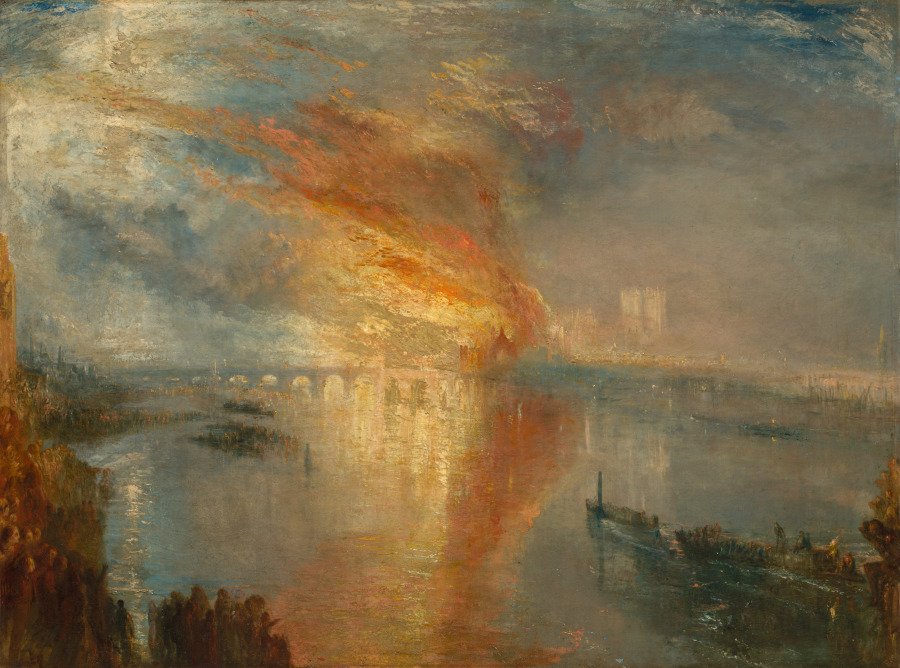
Licence: CC0 (Open Access)The Burning of the Houses of Lords and Commons, 16 October 1834
Boats are heading somewhere. Where to?
Toward the flames. A low tide made it hard to pump water, and slowed the steamers towing fire engines.
Turner saw the fire himself. In the painting he made the flames even higher than they were.

Widener Collection · 1942.9.86 · View at the museum
Licence: CC0 (Open Access)Keelmen Heaving in Coals by Moonlight
Turner signed this painting in an unusual place. Can you find it?
On the buoy: his initials, JMWT.
On the right, by firelight, men shovel coal onto the ships. On the left, the moon lights up the water.

J. Paul Getty Museum · CC0 · descriptions CC BY 4.0 · 2011.6 · View at the museum
Licence: CC0 (descriptions CC BY 4.0)Modern Rome – Campo Vaccino
Day is ending, yet something is already in the sky. What?
The moon, a pale disc in the haze, while the sun sets behind the Capitoline Hill on the right.
Turner showed it with a line from Byron: "The moon is up, and yet it is not night."

Given in memory of Governor Alvan T. Fuller by The Fuller Foundation, Inc. · 1961.2.3 · View at the museum
Licence: CC0 (Open Access)The Dogana and Santa Maria della Salute, Venice
Turner signed this one too. Where?
His initials, JMWT, as if written on the wall.
Venice dissolves in a golden haze: the customs house, the Dogana, and beyond it the white domes of the Salute church.

J. Paul Getty Museum · CC0 · descriptions CC BY 4.0 · 93.PA.32 · View at the museum
Licence: CC0 (descriptions CC BY 4.0)Van Tromp, going about to please his Masters, Ships a Sea, getting a Good Wetting
Someone on board is waving. Can you find him?
On the foredeck, a man in a white uniform waves with confidence, while spray breaks over the bow.
Probably the Dutch admiral Cornelis van Tromp, dismissed in 1666 and reconciled with his masters in 1673. Turner was 69.
The end of the tour
Light and weather.
Storms, fire, fog and sun: Turner made light and weather the subject itself. He died in London in 1851, aged 76, and left hundreds of paintings and thousands of drawings to the nation.
Questions at the end
Where did Turner sign Keelmen Heaving in Coals by Moonlight?
- On a floating buoy (correct)
- On a ship's sail
- In the moon
His initials, JMWT, are on the buoy. In the Venice painting they are on a wall.
What did Turner make bigger than it was in The Burning of the Houses of Lords and Commons?
- The flames (correct)
- The moon
- The bridge
He saw the fire himself, but painted the flames even higher than they were.
Which ship did Turner show three times in one painting?
- HMS Victory, Nelson's flagship (correct)
- The Mayflower
- The Titanic
He painted the Victory from three sides, all in one picture.
Works from these collections
More tours
- Artists of Switzerland in the world's museumsTen artists born or at home in Switzerland, from Liotard to Klee, in nine museums around the world.
- Animal huntEight animals are hiding in works of art from all over the world. Can you find them?
- 1,800 years of facesTen portraits, from Roman Egypt to Van Gogh. Look for the clues: who, when, and why?
- The world around 1600What were artists making around 1600? A journey westward from Japan to Spain, in ten works, most of them made within about ten years of that date.
- Blue and whiteHow cobalt blue on white travelled from China to Turkey, Holland, Japan, Mexico, Korea and England: ten pieces, roughly in the order they were made.
- The moonA god, a hare, a bodhisattva, a crescent, a castle, a jar, geese, photographs, the sea and a city by night: the moon in ten works from around the world.
- The seaWaves, a storm, a calm, a harbour and a sunrise: eight ways of looking at the sea, across 3,000 years.
- A walk through the seasonsA calm walk from spring to winter, in eight works. Large text, a gentle voice and no hurry.
- Look closerSeven famous works, each with a small detail most people miss. Find it yourself, then hear its story.
- How old is it?Eight works from four museums. Guess when each was made before you hear the story: some are far older than they look, and two are younger.
- Albrecht DürerEleven works by the painter and printmaker from Nuremberg: a self-portrait, a rhinoceros and a magic square.
- Rembrandt, in the mirrorTen self-portraits, painted, etched and drawn: from the curly-haired young man to the old master.
- VermeerThirteen of his rare paintings, in the order he made them: quiet rooms, letters and light.
- Giovanni Battista PiranesiRome, real and imagined, in the order he etched it: ruins, squares, prisons, temples and a fireplace.
- Hokusai & HiroshigeThe two masters of the Japanese landscape print, side by side: ten prints, in roughly the order they were made.
- Claude MonetEleven paintings in the order he made them: the sea, Camille, grainstacks, a cathedral, London fog and his pond.
- Mary CassattFrom Seville to Paris: a theatre box, a letter, an omnibus and a boat trip. Ten paintings, prints and a pastel, in the order she made them.
- Helene SchjerfbeckFrom a soldier in the snow to a face of a few strokes: ten works, in the order she made them.
- Van GoghTen years of work, from the grey Dutch coast to the colours of the south: eleven works, in the order he made them.
- Vilhelm HammershøiGrey rooms, white doors, light on the floor and a woman seen from behind: ten works, roughly in the order he made them.
Back to the start page · all tours · press