Guided tour · For everyone · Early photography · 1840s to 1908
Famous names, hidden hands
Fifteen early photographs, from the 1840s to 1908: famous names, hidden hands, and how photographs were made.
Start this tour in AuriaanOpens the interactive flight at this tour, with a guide's voice. It needs a modern browser; the same works are shown below.
- Works
- 15
- Time
- about 16 min
- Collections
- 8
About this tour
Early photography has its famous names, and many more makers we hardly know. On this tour, fifteen photographs from eight museums take turns between the two, and show how photographs were made, from blue prints of seaweed to the first snapshots. At every photograph, look first, then discover.
We begin in Britain, with a page from a book of blue photographs of seaweed.
The 15 works
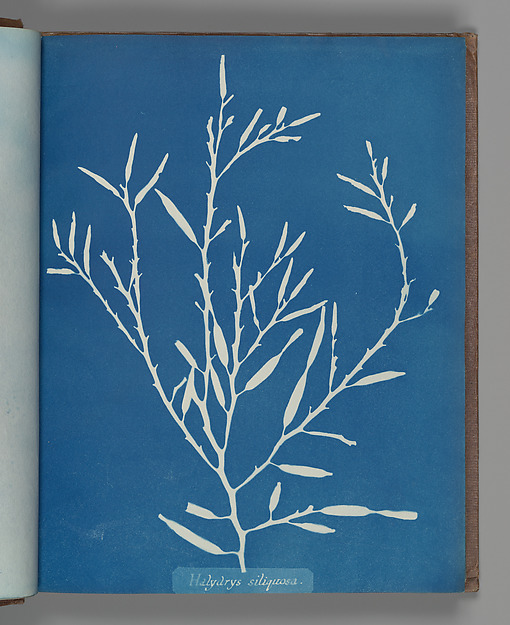
Gilman Collection, Purchase, The Horace W. Goldsmith Foundation Gift, through Joyce and Robert Menschel, 2005 · 2005.100.557 (15) · View at the museum
Licence: CC0 (Open Access)Halydrys siliquosa
The seaweed is white and everything around it is blue. Where do you think the seaweed was when this picture was made?
Right on the paper. Every little branch has a sharp outline, like a shadow: where the seaweed lay, the paper stayed white, and all around it, it turned blue.
No camera was needed: Anna Atkins laid the seaweed directly on paper coated with a light-sensitive solution, exposed it to light, then washed it in water. This is a cyanotype, a process invented by Sir John Herschel in 1842, which leaves a white shape on a deep blue ground. She began publishing her book of these plates in 1843 and labelled each plate in her own hand.

Robert B. Menschel and the Vital Projects Fund · 2012.40.2 · View at the museum
Licence: CC0 (Open Access)Portrait of a Man and Girl with Horse and Dog
Look at the horse's head, then at the man's face. Which one is blurred, and why?
The horse's head is blurred, while the man, the girl and the dog are sharp. The horse moved its head while the picture was being taken; the people kept still.
This is a daguerreotype: the picture sits directly on a sheet of silver-plated copper, polished until it looked like a mirror. There is no negative, so each one is unique. The earliest ones needed exposures of several minutes, and sitters had to stay perfectly still to avoid a blur.

J. Paul Getty Museum · CC0 · descriptions CC BY 4.0 · 84.XZ.571.3.2 · View at the museum
Licence: CC0 (descriptions CC BY 4.0)The Ladder
Look at the climbing plants on the wall and at the man in the window. How much fine detail can you make out?
Very little: the branches run together into soft brown tangles, and the man's face is a pale patch with hardly any features.
Talbot first made a negative on paper, with light and dark reversed, and then printed it onto paper coated with salt and silver. From one negative he could make many prints. Daguerreotypes were sharper, but each one was unique.

Gift of the UBS Art Collection · 2023.30.154 · View at the museum
Licence: CC0 (Open Access)Portrait of Two Sleigh Makers
Nobody wrote down these men's names. What in the picture tells us something about who they were?
Their work: between them stands a sleigh with long curved runners, and the man on the left wears a long striped apron. The title calls them sleigh makers.
This is a daguerreotype too, and again the record names neither the photographer nor the two men. They pose outdoors, beside a wooden building, with the sleigh in the middle.

Paris Musées / Musée Carnavalet · CC0 · PH19 · View at the museum
Licence: CC0Portrait of Jules Michelet (1798-1874), historian and writer
Look closely at his face and his white hair. How much fine detail can you make out?
A great deal, far more than in Talbot's picture: the lines on his forehead and around his eyes, his bushy eyebrows, the strands of his white hair.
Nadar, born Gaspard-Félix Tournachon, photographed many of the best-known people in Paris, here the historian Jules Michelet. Almost all his portraits were made on glass plates coated with wet collodion, a process invented in 1851: the plate had to be exposed while it was still wet. From one glass negative, many identical prints could be made.

Rijksmuseum, Amsterdam · Public Domain · RP-F-F00665-DN · View at the museum
Licence: Public DomainPortrait of a woman with a book
This little photograph does not stand on its own. What is it set into?
It is set into something bigger: the small card sits in a window with a rounded top, in a larger page framed with thin lines.
This is a carte de visite: a small photograph glued to a card the size of a visiting card, a format patented in 1854. Several pictures were taken on one plate. The cards were cheap, and people collected them in albums. The Rijksmuseum's record names the photographer, Johannes Moonen, and the place, Arnhem, but not the woman, and says this card is part of an album.

The Mary and Leigh Block Endowment Fund · 2001.59 · View at the museum
Licence: CC0 · descriptions CC BY 4.0Mrs. Herbert Duckworth
Under the oval, someone wrote a name by hand, very faintly. What does it say?
It says “Mrs Herbert Duckworth”, the title of the picture: a married woman's name.
This is an albumen print, on paper coated with egg white and salt, the most popular way of printing photographs in the nineteenth century. Julia Margaret Cameron began photographing at forty-eight, after her daughter and son-in-law gave her a camera. Her niece Julia Jackson, here under her married name, sat for her dozens of times.

J. Paul Getty Museum · CC0 · descriptions CC BY 4.0 · 84.XC.979.6788 · View at the museum
Licence: CC0 (descriptions CC BY 4.0)[Two men on a table about to paint a room, another man smoking a pipe in between the folds of the ladder]
The same three men are on this card twice. Why would someone put two almost identical pictures side by side?
To be looked at together, one with each eye: the two pictures sit side by side on one yellow card, almost exactly alike.
This is a stereograph: two photographs taken from slightly different positions, like our two eyes, and mounted side by side. Seen through a special viewer, the brain joins them into one picture with depth. Printed on albumen paper, stereographs could be made cheaply in large numbers, and this one carries no maker's name at all.
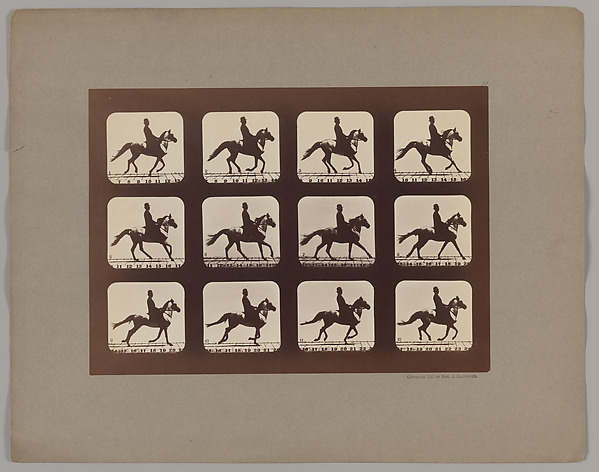
Gift of Joyce F. Menschel, 2015 · 2015.778.33 · View at the museum
Licence: CC0 (Open Access)Attitudes of Animals in Motion
Under the horse's hooves runs a line of numbers. How do the numbers change from one picture to the next?
They grow higher from one picture to the next: each picture caught the horse a little further along.
In 1872 Leland Stanford, a former governor of California, asked Eadweard Muybridge to photograph a horse galloping at full speed. Muybridge set up a battery of cameras, triggered at set intervals or when the horse's legs broke wires stretched above the ground. The pictures showed postures that the human eye had never been able to see.
Te Papa Tongarewa, Museum of New Zealand · No known copyright restrictions · C.014808 · View at the museum
Licence: No known copyright restrictions, CC0, CC BY or CC BY-SA, depending on the workRailway Workshops, Petone, Wellington
Dozens of men stand in front of these workshops. Read the writing along the bottom: what does it name, and what does it leave out?
It gives a number and a title, “3173 Railway Workshops Petone Wellington”, written on the glass plate, but no names: not of the men, and not of the photographer.
This is a gelatin dry plate, a glass negative that came ready-made from a factory and could be stored for weeks or months before use. Wet plates had to be coated and exposed on the spot, so photographers carried a darkroom with them. The record names the studio, Burton Brothers, but not the photographer behind the camera or any of the workers.

J. Paul Getty Museum · CC0 · descriptions CC BY 4.0 · 84.XP.901.7 · View at the museum
Licence: CC0 (descriptions CC BY 4.0)[School Children Looking at Elk]
Look at the girls' white dresses, then at the dark elk. What can you still make out in the brightest and in the darkest parts?
The white dresses show their frills and folds in pale greys, and the dark elk still show their ears, legs and the shading of their coats. In between lie many soft greys.
Frances Benjamin Johnston opened a studio in Washington, D.C., around 1890 and was one of the first American women to achieve prominence as a photographer. This is a platinum print, popular with art photographers around 1900 for its delicate surface and subtle greys.

Gift of Robert E. Jackson · 2007.4.20 · View at the museum
Licence: CC0 (Open Access)No. 2 Kodak family photograph album
Compare the two round pictures at the top. What is the same in both, and what has changed?
The same two boys stand on the same rock in the water. In the left picture they have their backs to the camera; in the right one they have turned round and face it. Whoever held the camera took the scene twice.
Taking a scene twice was easy with a whole roll of film in the camera. The first Kodak camera, from 1888, came loaded with a roll of film for 100 pictures and made round snapshots like these. When the roll was used up, the camera went back to the company and came home reloaded, with the negatives and prints. No photographer's name is on this page, only “Wanakah 1892”.

Yale University Art Gallery · Public Domain · 1976.58 · View at the museum
Licence: Public DomainWinter - Fifth Avenue
Look under the picture. What is printed there, and what does that make this picture look like?
The title, “Winter – Fifth Avenue”, in capital letters, and at the right, in tiny letters, “By Alfred Stieglitz”. It looks like a page from a book.
The letters and the picture are both printed in ink. Alfred Stieglitz made this picture in a New York blizzard in 1893, walking the streets with a hand-held camera instead of a big camera on a tripod. This print is a photogravure: the photograph was transferred to a copper plate, which was etched, inked and printed, so the image is made of ink. Stieglitz later published a magazine, Camera Work, illustrated with photogravures.

Rijksmuseum, Amsterdam · Public Domain · RP-F-F22340 · View at the museum
Licence: Public DomainPortrait of a dog
Look at the bottom of the card. What does it tell you about who made this picture, and where, and what does it leave out?
It is printed with the photographer's name, in flowing letters, and the town, Arnhem. The dog's name is nowhere.
This is a carte de visite too, made between 1898 and 1915, more than forty years after the format was patented. The Rijksmuseum's record names the photographer, Wilhelm Moonen, and the town, Arnhem, but not the dog.

Paris Musées / Musée Carnavalet · CC0 · PH3894 · View at the museum
Licence: CC0Enseigne, restaurant “Au tambour”, 63 quai de la Tournelle, 5th arrondissement, Paris
Above the windows the front says only “Restaurant” and “Vins”, wines. The restaurant is called “Au tambour”, At the Drum. Find the two places where the front shows that name as a picture instead of in letters.
A drum hangs over the door as the sign, and on the wall above, between the windows, a painted drummer carries another.
The title of this print begins with “Enseigne”, the French word for a shop sign. Eugène Atget photographed the streets, courtyards and shop windows of Paris, and built up an archive of over 8,000 negatives. In the 1920s Man Ray and the Surrealists praised his work; this print, on albumen paper, is in the Musée Carnavalet.

The end of the tour
Famous names, hidden hands.
From the cyanotype and the daguerreotype to the Kodak snapshot: fifteen photographs, and the ways they were made. Atkins, Talbot, Nadar, Cameron, Muybridge, Johnston, Stieglitz and Atget are famous names; beside them stood makers the records barely name. In Auriaan, the Rijksmuseum alone has more than 16,000 cartes de visite: hidden hands, waiting to be found among the stars.
Works from these collections
- The Metropolitan Museum of Art
- National Gallery of Art
- J. Paul Getty Museum
- Paris Musées
- Rijksmuseum
- Art Institute of Chicago
- Te Papa Tongarewa
- Yale University Art Gallery
More tours
- Artists of Switzerland in the world's museumsTen artists born or at home in Switzerland, from Liotard to Klee, in nine museums around the world.
- Animal huntEight animals are hiding in works of art from all over the world. Can you find them?
- 1,800 years of facesTen portraits, from Roman Egypt to Van Gogh. Look for the clues: who, when, and why?
- The world around 1600What were artists making around 1600? A journey westward from Japan to Spain, in ten works, most of them made within about ten years of that date.
- Blue and whiteHow cobalt blue on white travelled from China to Turkey, Holland, Japan, Mexico, Korea and England: ten pieces, roughly in the order they were made.
- The moonA god, a hare, a bodhisattva, a crescent, a castle, a jar, geese, photographs, the sea and a city by night: the moon in ten works from around the world.
- The seaWaves, a storm, a calm, a harbour and a sunrise: eight ways of looking at the sea, across 3,000 years.
- A walk through the seasonsA calm walk from spring to winter, in eight works. Large text, a gentle voice and no hurry.
- Look closerSeven famous works, each with a small detail most people miss. Find it yourself, then hear its story.
- How old is it?Eight works from four museums. Guess when each was made before you hear the story: some are far older than they look, and two are younger.
- Albrecht DürerEleven works by the painter and printmaker from Nuremberg: a self-portrait, a rhinoceros and a magic square.
- Rembrandt, in the mirrorTen self-portraits, painted, etched and drawn: from the curly-haired young man to the old master.
- Giovanni Battista PiranesiRome, real and imagined, in the order he etched it: ruins, squares, prisons, temples and a fireplace.
- J. M. W. TurnerStorms, fire, moonlight and golden haze, in order of date: from a Welsh castle to a storm at sea.
- Hokusai & HiroshigeThe two masters of the Japanese landscape print, side by side: ten prints, in roughly the order they were made.
- Claude MonetEleven paintings in the order he made them: the sea, Camille, grainstacks, a cathedral, London fog and his pond.
- Mary CassattFrom Seville to Paris: a theatre box, a letter, an omnibus and a boat trip. Ten paintings, prints and a pastel, in the order she made them.
- Helene SchjerfbeckFrom a soldier in the snow to a face of a few strokes: ten works, in the order she made them.
- Van GoghTen years of work, from the grey Dutch coast to the colours of the south: eleven works, in the order he made them.
- Vilhelm HammershøiGrey rooms, white doors, light on the floor and a woman seen from behind: ten works, roughly in the order he made them.
Back to the start page · all tours · press